
The AI Career Landscape - Find Your Path Into AI
Reading time: ~20 min | Interview relevance: Critical | Roles: All
The Real Interview Moment
You just landed a recruiter call from a top AI company. They ask: "So, which role are you targeting - MLE, AI Engineer, or MLOps?"
You freeze. You've been studying "AI interviews" generically for weeks. You've solved LeetCode, read transformer papers, and built a RAG chatbot. But you never actually figured out which role you're interviewing for - and now you realize each role has a completely different interview loop, different expectations, and different career trajectory.
The recruiter waits. You say "Machine Learning Engineer" because it sounds right. But your background is in building products, not training models. You've just signed up for a 6-round interview loop that tests statistical modeling, experimentation design, and distributed training - none of which play to your strengths. Meanwhile, the AI Engineer role would have been a perfect fit.
This section exists so that never happens to you. Before you solve a single problem, you need to know exactly which role you're targeting, what that role actually does day-to-day, and what its interview loop tests. Everything else in this handbook flows from that decision.
What You Will Master
After this section, you will be able to:
- Clearly distinguish between 6 core AI/ML roles and articulate the differences in 60 seconds
- Identify which role best matches your current skills, interests, and experience
- Understand the typical interview loop for each role and what each round tests
- Navigate salary bands across companies, levels, and geographies
- Map career ladders from entry-level to staff/principal for each track
- Evaluate industry vs. research career paths with a decision framework
- Identify emerging roles (AI Safety, ML Platform, Prompt Engineer) and their viability
- Build a personal brand strategy that makes recruiters come to you
- Create a targeted prep plan based on your chosen role
- Avoid the most common career mistakes that derail AI job searches
Self-Assessment: Where Are You Now?
Rate yourself 1–5 on each dimension. Be honest - this determines where you should focus.
| Dimension | 1 (Beginner) | 3 (Some experience) | 5 (Expert) | Your Rating |
|---|---|---|---|---|
| Role clarity | "AI is AI, right?" | Know MLE vs DS difference | Can explain 6 roles to a friend | ___ |
| Interview knowledge | Never done an AI interview | Done 1-2 phone screens | Completed full loops | ___ |
| Salary awareness | No idea what to expect | Know ballpark ranges | Can negotiate with data | ___ |
| Career planning | Just want "an AI job" | Have a target role | Have a 3-year career arc | ___ |
| Industry awareness | Don't follow AI hiring trends | Read some blog posts | Track openings, know market cycles | ___ |
Score interpretation:
- 5–10: Read every page in this section carefully. This is your foundation.
- 11–18: Skim the Overview, deep-dive into your target role, then jump to Interview Process.
- 19–25: You probably know this. Skip to ML Fundamentals or System Design.
Part 1 - The Six Core AI/ML Roles
The AI/ML job market has evolved from "data scientist does everything" to a specialized ecosystem. Here's how the roles relate:

Role Comparison Matrix
| Dimension | MLE | AI Engineer | MLOps | Data Scientist | Research Eng. | Data Engineer |
|---|---|---|---|---|---|---|
| Primary focus | Train & deploy models | Build AI products | ML infrastructure | Analysis & experimentation | Implement papers | Data pipelines |
| Key skill | PyTorch + distributed training | LLM APIs + RAG + agents | Kubernetes + CI/CD | Statistics + SQL | Math + PyTorch | Spark + Airflow |
| Interview emphasis | ML theory + coding + design | System design + coding + LLM knowledge | Infra design + SRE + ML basics | Stats + SQL + case studies | Paper discussion + coding | Data modeling + SQL + pipelines |
| Typical TC (L5, US) | $300\text{--}450K | $250–400K | $250\text{--}380K | $220–350K | $280\text{--}420K | $220–340K |
| Supply/Demand (2026) | Balanced | High demand, low supply | High demand | Oversupplied | Scarce roles | Balanced |
| Coding intensity | High | Very high | High | Medium | High | High |
| Research reading | Some | Some | Rare | Some | Daily | Rare |
| Path to Staff+ | IC or Manager | IC or Manager | IC or Manager | IC or Manager | IC or Research Lead | IC or Manager |
When we ask "which role are you targeting?", we're testing whether you understand what you're signing up for. Candidates who can clearly articulate the difference between an MLE and an AI Engineer - and explain why they want one over the other - demonstrate the self-awareness we look for in senior hires.
Quick Decision Flowchart
Not sure which role fits? Walk through this:
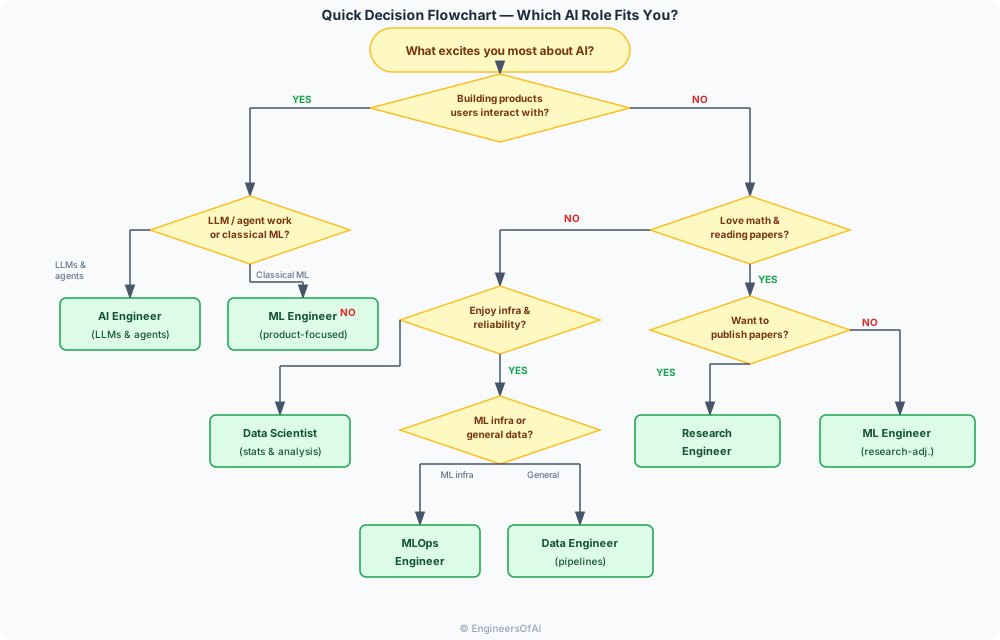
"The AI career landscape has six core roles. ML Engineers train and deploy models. AI Engineers build products using LLMs and agents. MLOps Engineers handle the infrastructure and reliability side. Data Scientists focus on statistical analysis and experimentation. Research Engineers implement and scale cutting-edge papers. Data Engineers build the data pipelines that feed everything else. Each has a different interview loop, different skill requirements, and different career trajectory."
Part 2 - How Interview Loops Differ by Role
Understanding the interview loop for your target role is critical - it determines what you study.
| Round | MLE | AI Engineer | MLOps | Data Scientist |
|---|---|---|---|---|
| Phone screen | ML concepts + coding | System design + coding | Infra concepts + coding | Stats + SQL |
| Coding 1 | DSA (LeetCode Medium) | DSA (LeetCode Medium) | DSA (LeetCode Medium) | DSA (LeetCode Easy-Med) |
| Coding 2 | ML-specific coding (implement gradient descent, build a pipeline) | ML-specific coding (build a RAG pipeline, fine-tune a model) | Infrastructure coding (write a deployment script, debug a pipeline) | Data manipulation (Pandas, SQL) |
| ML depth | Deep: loss functions, optimization, regularization | Moderate: LLM internals, RAG, evaluation | Light: ML basics, model serving concepts | Deep: statistics, A/B testing, causal inference |
| System design | ML system (rec system, fraud detection) | AI product (chatbot, search, agent system) | ML platform (feature store, model registry) | Experimentation platform or metrics system |
| Behavioral | Project depth, cross-team collaboration | Product sense, iteration speed | Incident response, reliability culture | Business impact, stakeholder communication |
| Unique round | Paper discussion (sometimes) | Product sense / demo | On-call / incident simulation | Case study / business analysis |
Studying for "AI interviews" generically is the #1 mistake. An MLE studying RAG pipelines is wasting time if their loop has a paper discussion round. An AI Engineer grinding statistics problems is misallocating effort. Know your loop, study for your loop.
Part 3 - The 2026 Market Reality
Demand Heatmap by Role
| Role | FAANG | AI Startups | Enterprise | Finance | Healthcare |
|---|---|---|---|---|---|
| MLE | 🟢 High | 🟢 High | 🟡 Medium | 🟢 High | 🟡 Medium |
| AI Engineer | 🟢 High | 🔥 Very High | 🟢 High | 🟡 Medium | 🟡 Medium |
| MLOps | 🟢 High | 🟡 Medium | 🟢 High | 🟢 High | 🟡 Medium |
| Data Scientist | 🟡 Medium | 🟠 Low | 🟡 Medium | 🟢 High | 🟢 High |
| Research Eng. | 🟡 Medium | 🟢 High | 🟠 Low | 🟠 Low | 🟠 Low |
| Data Engineer | 🟢 High | 🟡 Medium | 🟢 High | 🟢 High | 🟢 High |
Key Market Trends (2026)
- AI Engineer is the fastest-growing role. Every company shipping AI products needs them. Supply hasn't caught up.
- "Data Scientist" title is splitting. Some companies mean statistician, others mean MLE. Always clarify.
- MLOps demand is surging as companies move from "we have a model" to "we have a reliable ML system."
- Research Engineer roles are concentrating at frontier labs (OpenAI, Anthropic, DeepMind, Meta FAIR). Rare elsewhere.
- Hybrid roles are emerging. "ML Platform Engineer," "AI Safety Engineer," "LLM Ops" - see Emerging Roles.
- Google/Meta: Still hire traditional MLEs heavily. Strong coding bar.
- OpenAI/Anthropic: Research Engineer or "Member of Technical Staff" - blurs MLE/RE.
- Startups (<50 people): Want AI Engineers who can do everything. Title matters less.
- Enterprise (banks, healthcare): Data Scientist and MLOps are king. Compliance matters.
Section Roadmap
Here's what each page in this section covers and who should read it:

| Page | Best For | Skip If |
|---|---|---|
| Machine Learning Engineer | Anyone considering MLE roles | You're certain about a non-MLE role |
| AI Engineer | Product-focused builders, LLM enthusiasts | You want pure research |
| MLOps Engineer | Infra-minded engineers, SREs entering AI | You have no interest in infrastructure |
| Data Scientist | Statisticians, analysts moving to AI | You hate SQL |
| Research Engineer | PhD-track, paper implementers | You prefer product work |
| Data Engineer | Pipeline builders, data architects | You want to train models |
| Salary Bands | Everyone (know your worth) | Never skip this |
| Career Ladders | Anyone planning 3+ years ahead | You just need to pass one interview |
| Industry vs Research | People torn between academia and industry | You're already committed |
| Emerging Roles | People curious about AI Safety, ML Platform, etc. | You have a clear target already |
| Building Your Brand | Everyone who wants inbound recruiter interest | You already have strong inbound |
Practice Problems
Problem 1: Role Matching
A friend tells you: "I love building things users interact with. I've been playing with LangChain and built a chatbot. I know some ML basics but I'm not super deep on math. Should I apply as an MLE?"
Hint 1 - Direction
Think about what this person enjoys (product building, LLM tools) vs. what an MLE interview tests (deep ML theory, statistical modeling, distributed training).
Hint 2 - Key Insight
The AI Engineer role was created specifically for people like this. Product-focused, LLM-native, building with APIs and frameworks rather than training from scratch.
Full Answer + Rubric
Strong answer: "You should target AI Engineer, not MLE. Your interest in product building and LLM tooling aligns perfectly. An MLE interview would test you on gradient descent math, distributed training, and statistical theory - areas where you'd be at a disadvantage. As an AI Engineer, your chatbot experience is directly relevant, and the interview will focus on system design with LLMs, RAG architecture, and production coding - all areas where your experience gives you an edge."
Scoring:
- Strong Hire: Correctly identifies AI Engineer, explains why with specific interview loop differences
- Lean Hire: Says AI Engineer but can't articulate the interview differences
- No Hire: Says MLE is fine, or doesn't know the roles differ
Problem 2: Career Transition
You're a backend engineer with 5 years of experience. You've taken some ML courses and fine-tuned a model on Hugging Face. Which role should you target, and what's your biggest gap?
Hint 1 - Direction
Consider which roles value strong software engineering skills. Think about what you'd need to learn vs. what you already know.
Hint 2 - Key Insight
Backend engineers have two natural entry points into AI: AI Engineer (product-building with LLMs) or MLOps (infrastructure for ML). Your choice depends on whether you want to build features or build platforms.
Full Answer + Rubric
Strong answer: "A backend engineer with some ML experience has two strong options: AI Engineer or MLOps. For AI Engineer, your strength is production coding and system design - you can build reliable, scalable AI products. Your gap is LLM-specific knowledge: RAG patterns, prompt engineering, evaluation methods, and agent architectures. For MLOps, your strength is infrastructure, CI/CD, and reliability thinking. Your gap is ML pipeline specifics: feature stores, model registries, training infrastructure, and ML-specific monitoring. I'd recommend AI Engineer if you enjoy building products users touch, or MLOps if you prefer platform/infrastructure work."
Scoring:
- Strong Hire: Identifies both options, articulates strengths and gaps for each, gives decision criteria
- Lean Hire: Picks one role correctly but doesn't contrast alternatives
- No Hire: Suggests MLE without acknowledging the ML theory gap
Problem 3: Market Timing
Your company just laid off its ML team. You need a job in 3 months. You have MLE experience but are open to other roles. How do you maximize your chances?
Hint 1 - Direction
Think about which roles have the highest demand-to-supply ratio right now and how quickly you could become competitive in them.
Full Answer + Rubric
Strong answer: "With a 3-month timeline, I'd dual-track: apply for MLE roles (my existing strength) while also preparing for AI Engineer roles (highest demand-to-supply ratio in 2026). My MLE background gives me strong fundamentals. To become competitive as an AI Engineer, I'd need 4-6 weeks to get sharp on LLM APIs, RAG patterns, and agent architectures - all buildable quickly given my ML foundation. I'd cast a wider net by applying to both role types, and I'd prioritize AI startups where hiring timelines are 2-4 weeks vs. FAANG's 6-8 weeks."
Scoring:
- Strong Hire: Dual-tracks, considers market dynamics, has a timeline-aware strategy
- Lean Hire: Has a reasonable strategy but misses the market demand angle
- No Hire: Plans to only apply for one type of role without considering alternatives
Interview Cheat Sheet
| Question Pattern | Framework | Key Phrases |
|---|---|---|
| "Tell me about yourself" with role ambiguity | Role Clarity Framework: State target role → Why it fits your background → What excites you about it | "I'm targeting X because my strength in Y directly maps to the core responsibility of Z" |
| "Why this role and not [other role]?" | Contrast Framework: Acknowledge the other role → Explain the difference → Connect to your strengths | "While MLEs focus on training models, I'm drawn to AI Engineering because I love building the product layer on top of those models" |
| "Where do you see yourself in 5 years?" | Career Ladder Framework: Current role → Skills to build → Target senior title → Impact at that level | "I see myself as a Staff AI Engineer, leading the architecture for how we integrate AI across the product" |
| "How do you stay current?" | Learning Signal Framework: Papers/blogs → Side projects → Community → How you apply learnings at work | "I read the weekly ArXiv digest, build prototypes of interesting ideas, and bring relevant findings to our team's design reviews" |
Spaced Repetition Checkpoints
Use this schedule to lock in the role landscape knowledge:
- Day 0 (today): Read this overview. Take the self-assessment. Pick your top 2 target roles.
- Day 3: Without looking, write down the 6 roles and their key differences. Check against the comparison matrix.
- Day 7: Explain to a friend (or rubber duck) why you chose your target role and how its interview loop differs from adjacent roles.
- Day 14: Review the market trends. Has anything changed in the job postings you're seeing?
- Day 21: Re-take the self-assessment. Your scores should have improved. If not, re-read the pages for your target role.
What's Next
Pick your target role and deep-dive:
- Machine Learning Engineer - The core model-building role
- AI Engineer - The product-building LLM role
- MLOps Engineer - The infrastructure and reliability role
Or if you already know your role, jump to The Interview Process to understand what you're walking into.