
Behavioral Interviews for AI Roles - The Human Side of AI Hiring
Reading time: ~25 min | Interview relevance: Critical | Roles: MLE, Research Scientist, Applied Scientist, AI Engineer, MLOps
The Real Interview Moment
You have just finished a flawless system design round. Your architecture for a real-time recommendation engine was praised - distributed feature store, A/B testing framework, fallback strategies. The interviewer smiled and said, "Impressive." You are feeling confident. Then the hiring manager walks in for the final round and asks:
"Tell me about a time you fundamentally disagreed with your team about an ML approach. What happened?"
Your mind goes blank. You start rambling about a random disagreement over hyperparameter tuning. You mention it was resolved "eventually." You cannot recall specific metrics. You forget to mention what you learned. The interviewer nods politely but writes almost nothing down. Thirty minutes later, the round ends and you leave with a sinking feeling.
Two days later, the recruiter calls: "The team really liked your technical skills, but they had concerns about collaboration and communication. Unfortunately, we won't be moving forward."
This happens more often than you think. Companies report that 40-60% of candidates who pass technical rounds are rejected based on behavioral signals. In AI specifically, where teams are small, projects are ambiguous, and cross-functional communication is constant, behavioral interviews carry enormous weight. This chapter will make sure you never walk into that round unprepared again.
What You Will Master
- Why behavioral interviews carry disproportionate weight in AI hiring decisions
- The six core competencies every AI behavioral interview evaluates
- How behavioral interviews differ for AI/ML roles vs. traditional software engineering
- A complete preparation framework that takes 2-3 weeks
- Company-specific behavioral philosophies (FAANG, startups, research labs)
- How to build and maintain a story bank tailored to ML experiences
- Chapter-by-chapter roadmap for mastering every behavioral category
Self-Assessment: Where Are You Now?
| Level | Description | Target |
|---|---|---|
| Unprepared | "I'll just wing it - my projects speak for themselves" | Read everything, start building your story bank immediately |
| Basic | "I know the STAR method but haven't practiced ML-specific stories" | Focus on STAR for ML, project deep-dives, and practice exercises |
| Intermediate | "I have some stories prepared but struggle with follow-up questions" | Focus on deep-dives, failure stories, and ethics sections |
| Strong | "I'm comfortable with behavioral but want to polish for specific companies" | Jump to company-specific sections and the common questions bank |
Part 1 - Why Behavioral Interviews Matter More Than You Think
The Uncomfortable Truth
Most AI/ML candidates spend 80-90% of their preparation time on technical content: coding, ML theory, system design, and paper discussions. They treat behavioral interviews as an afterthought - something they can handle with natural conversational skills.
This is a critical mistake. Here is what hiring managers actually report:
| Decision Factor | Weight in Final Hiring Decision |
|---|---|
| Technical coding skills | 25-30% |
| ML/AI domain knowledge | 20-25% |
| System design ability | 15-20% |
| Behavioral and cultural fit | 25-35% |
| Communication clarity | (embedded in all rounds) |
"I'm a strong technical candidate, so behavioral is just a formality." This mindset leads to the most preventable rejections in AI hiring. Companies use behavioral rounds as veto gates - a single red flag (inability to handle conflict, poor self-awareness, no evidence of learning from mistakes) can override strong technical performance.
Why AI Roles Demand More Behavioral Rigor
AI/ML roles face behavioral scrutiny that goes beyond standard software engineering interviews. Here is why:
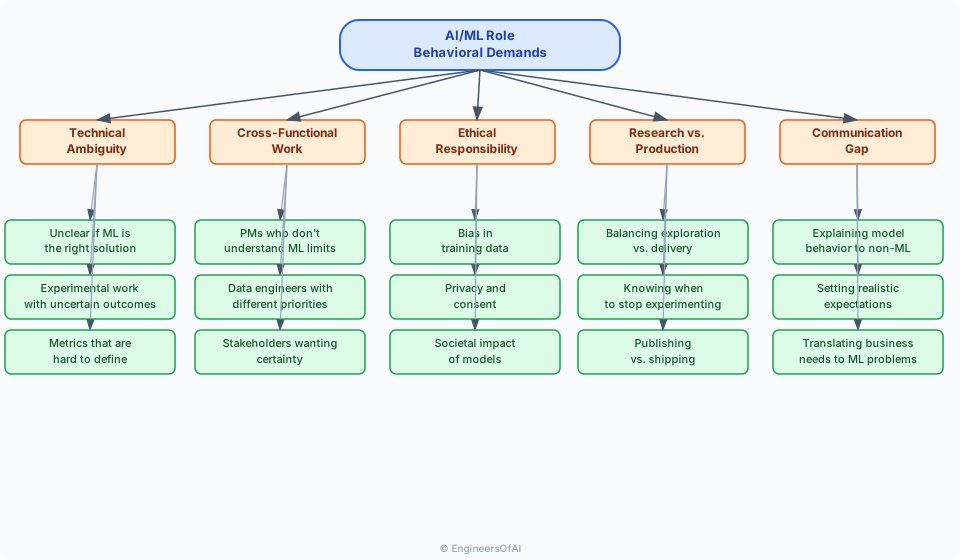
"Behavioral interviews for AI roles test whether you can operate effectively in an environment that is uniquely ambiguous, cross-functional, and ethically consequential. Unlike traditional SWE where requirements are clearer, ML work involves constant experimentation, communicating uncertainty to stakeholders, navigating research-vs-production tradeoffs, and making responsible decisions about data and model deployment. Companies need evidence that you can handle all of this while collaborating effectively."
The Six Core Competencies
Every behavioral interview for AI roles evaluates some combination of these six competencies, though different companies weight them differently:
| Competency | What It Means | ML-Specific Dimension | Chapter |
|---|---|---|---|
| Structured Problem Solving | Breaking down ambiguous problems | Framing ML problems, choosing metrics, scoping experiments | STAR for ML |
| Technical Depth & Ownership | Deep understanding of your own work | Explaining model choices, trade-offs, production challenges | Project Deep-Dives |
| Collaboration & Communication | Working across functions | Explaining ML to non-technical people, cross-team alignment | Teamwork & Communication |
| Resilience & Growth | Learning from setbacks | Failed experiments, model regressions, data disasters | Handling Failure |
| Ethical Judgment | Responsible decision-making | Bias detection, fairness, privacy, deployment ethics | Ethics & Responsible AI |
| Leadership & Influence | Driving outcomes without authority | Advocating for ML best practices, mentoring, setting direction | Leadership & Influence |
A seventh meta-competency - navigating ambiguity and prioritization - cuts across all six and is covered in Ambiguity & Prioritization.
Part 2 - How Behavioral Interviews Actually Work
The Mechanics
A typical behavioral round lasts 45-60 minutes and covers 3-5 questions. Here is what a standard flow looks like:
| Time | Activity | Your Goal |
|---|---|---|
| 0-3 min | Introductions and small talk | Be warm, professional, and concise |
| 3-8 min | Question 1 (often a project deep-dive) | Deliver a structured 3-4 minute story, handle 2-3 follow-ups |
| 8-20 min | Question 2 (collaboration or conflict) | Show self-awareness and growth |
| 20-35 min | Question 3-4 (failure, leadership, or ethics) | Demonstrate maturity and judgment |
| 35-45 min | Your questions for the interviewer | Ask thoughtful questions about team culture and ML challenges |
Amazon conducts behavioral assessment in every single round (including technical rounds) using their Leadership Principles. Google has a dedicated "Googleyness and Leadership" round. Meta evaluates behavioral signals through a "Culture Fit" round. Startups often blend behavioral assessment into the hiring manager conversation. Research labs (DeepMind, Anthropic, OpenAI) focus heavily on intellectual curiosity, ethics, and collaboration during team-match conversations.
What Interviewers Are Actually Writing Down
Understanding the evaluation rubric helps you target your answers. Most companies use a structured scorecard:

These behavioral signals result in immediate "no hire" decisions at most companies:
- Badmouthing previous employers or teammates - Even if they were genuinely terrible, frame it constructively
- Inability to name a single failure - Signals either dishonesty or dangerous lack of self-awareness
- Taking sole credit for team accomplishments - Especially toxic signal in collaborative ML environments
- Ethical indifference - "I just build what they tell me to build" is a disqualifying answer for AI roles
- No questions for the interviewer - Signals lack of genuine interest in the role and team
The Hidden Evaluation: How You Tell the Story
Beyond the content of your answers, interviewers evaluate how you communicate:
| Signal | Positive | Negative |
|---|---|---|
| Structure | Clear beginning, middle, end | Rambling, jumping between topics |
| Specificity | "We improved precision from 0.72 to 0.89" | "We made the model better" |
| Self-awareness | "In retrospect, I should have..." | "Everything went perfectly" |
| Ownership | "I drove the decision to..." | "The team decided to..." (always) |
| Proportion | 70% your actions, 30% context | All context, no personal contribution |
| Listening | Answers the actual question asked | Pivots to a rehearsed story that doesn't fit |
| Authenticity | Natural delivery with genuine reflection | Obviously memorized script |
Part 3 - The Complete Preparation Framework
Phase 1: Build Your Story Bank (Week 1)
Your story bank is a collection of 7-10 detailed experiences from your ML career that you can adapt to different behavioral questions. Each story should be written out in full STAR format.
Step 1: List Your ML Experiences
Write down every significant ML project, challenge, or situation you have been involved in. Include:
- Major projects (shipped models, research papers, proof-of-concepts)
- Failures and pivots (experiments that did not work, models that degraded)
- Cross-functional experiences (working with PMs, business stakeholders, data teams)
- Technical decisions you drove (architecture choices, tool selections, methodology changes)
- Mentoring or leadership moments (code reviews, onboarding, setting standards)
- Ethical dilemmas (bias discovery, privacy concerns, questionable requests)
Step 2: Map Stories to Competencies
| Story | Problem Solving | Technical Depth | Collaboration | Failure/Growth | Ethics | Leadership |
|---|---|---|---|---|---|---|
| Recommendation model redesign | X | X | X | |||
| Data pipeline migration | X | X | X | |||
| Bias discovery in hiring model | X | X | X | |||
| Failed NLP experiment | X | X | X | |||
| Cross-team feature store initiative | X | X | ||||
| Production model degradation | X | X | X | |||
| Stakeholder pushback on model uncertainty | X |
"A strong story bank has 7-10 stories where each maps to multiple competencies. The best stories are 'versatile' - they can be reshaped to answer questions about collaboration, failure, leadership, or technical depth depending on which aspect you emphasize. You should never need more than 10 stories to cover any behavioral question you encounter."
Step 3: Write Each Story in Full STAR Format
For each story, write a complete narrative covering:
- Situation: Context, team, timeline, stakes (2-3 sentences)
- Task: Your specific responsibility and the challenge (1-2 sentences)
- Action: What YOU did - specific, detailed steps (4-6 sentences)
- Result: Quantified impact, lessons learned, what changed (2-3 sentences)
See STAR for ML for detailed templates and examples.
Phase 2: Practice Delivery (Week 2)
Calibrate Your Timing
| Story Length | When to Use | Risk |
|---|---|---|
| 90 seconds | Quick follow-ups, "give me another example" | May lack depth |
| 2-3 minutes | Standard behavioral answer | Sweet spot for most questions |
| 4-5 minutes | Project deep-dives, "walk me through..." | Risk of rambling |
| 6+ minutes | Never | Interviewer will cut you off or zone out |
Practice Methods (Ranked by Effectiveness)
- Mock interviews with ML peers - Best signal; they can evaluate technical plausibility
- Record yourself and review - Painful but effective; catches rambling and filler words
- Written rehearsal - Write out answers, then practice delivering them naturally (not memorized)
- Mirror practice - Good for body language and eye contact awareness
- Mental rehearsal - Minimum viable practice; better than nothing
Phase 3: Company-Specific Tuning (Week 3)
Different companies emphasize different behavioral dimensions:
| Company | Primary Focus | Secondary Focus | Key Behavioral Framework |
|---|---|---|---|
| Amazon | Leadership Principles (16) | Customer obsession, bias for action | Every answer must map to an LP |
| Googleyness, leadership | Intellectual humility, collaboration | "Googleyness and Leadership" round | |
| Meta | Move fast, impact | Collaboration, openness | Culture fit + "Why Meta?" |
| Apple | Craft, secrecy, attention to detail | Cross-functional collaboration | "Why Apple?", design thinking |
| Microsoft | Growth mindset | Collaboration, customer empathy | Carol Dweck's framework embedded |
| Netflix | Judgment, candor | Freedom and responsibility | Culture deck alignment |
| Anthropic | Safety consciousness, intellectual honesty | Collaborative research, ethical reasoning | AI safety values alignment |
| OpenAI | Mission alignment, velocity | Technical ambition, pragmatism | "Why AGI matters to you?" |
| DeepMind | Research rigor, intellectual curiosity | Collaboration, scientific integrity | Academic + industry hybrid |
| Startups | Ownership, scrappiness | Ambiguity tolerance, speed | "Can you do 10 things at once?" |
Amazon's Leadership Principles deserve special attention because they are the most structured behavioral framework in tech. Amazon interviewers are trained to evaluate every answer against specific LPs. The most commonly tested for ML roles are: Customer Obsession, Dive Deep, Invent and Simplify, Bias for Action, Have Backbone, Disagree and Commit, and Learn and Be Curious. Each answer should explicitly connect to 1-2 LPs.
Part 4 - Behavioral Interviews by Role and Seniority
How Expectations Scale with Level

| Seniority | Story Scope | Expected Impact | Leadership Signal |
|---|---|---|---|
| Junior | Individual task or small feature | Personal learning, team contribution | Following processes, asking good questions |
| Mid-Level | Full project or feature | Team-level impact, measurable metrics | Driving decisions, mentoring juniors |
| Senior | Multi-project or cross-team initiative | Org-level impact, strategic direction | Influencing strategy, setting standards |
| Staff+ | Organizational or company-wide impact | Business outcomes, industry impact | Defining vision, building organizations |
One of the most common mistakes in behavioral interviews is telling stories at the wrong scope for your target level. If you are interviewing for a senior role but only tell stories about individual bug fixes, the interviewer will question your readiness. Conversely, if you are interviewing for a mid-level role and only talk about organizational strategy, you may seem disconnected from the hands-on work.
Role-Specific Behavioral Emphasis
| Role | Top Behavioral Questions | Why |
|---|---|---|
| ML Engineer | Project depth, production challenges, collaboration with data/backend teams | Need to ship reliable ML systems |
| Research Scientist | Paper discussions, intellectual disagreements, exploration vs. exploitation | Need to do rigorous research |
| Applied Scientist | Business impact, stakeholder communication, experiment prioritization | Bridge between research and product |
| AI Engineer | System integration, rapid prototyping, adapting to new tools quickly | Need to build AI-powered products fast |
| MLOps Engineer | Production incidents, automation decisions, cross-team dependencies | Need to keep ML systems running |
| Data Scientist | Insight communication, ambiguity in analysis, stakeholder management | Need to drive decisions with data |
Part 5 - Common Mistakes and How to Avoid Them
The Top 10 Behavioral Interview Mistakes for ML Candidates
| # | Mistake | Why It Happens | Fix |
|---|---|---|---|
| 1 | No preparation | Overconfidence from technical skills | Build a story bank 2+ weeks before |
| 2 | Generic stories | Using non-ML examples for ML roles | Every story should involve ML/data/models |
| 3 | No metrics | Forgetting to quantify ML-specific impact | Always include precision, latency, revenue, or adoption numbers |
| 4 | Blaming others | Genuine frustration leaking through | Reframe as "I could have done X differently" |
| 5 | Rambling | Nervousness or poor story structure | Practice the 2-3 minute version |
| 6 | Too technical | Treating behavioral as a tech round | Focus on decisions, trade-offs, and people |
| 7 | No failure stories | Fear of looking incompetent | Prepare 2-3 authentic failure stories with growth |
| 8 | Memorized scripts | Over-preparation without flexibility | Know key beats but deliver naturally |
| 9 | Not asking questions | Running out of time or forgetting | Prepare 5+ questions, ask the best 2-3 |
| 10 | Ignoring the follow-up | Panicking when pressed for details | Prepare "depth layers" for each story |
The single most damaging pattern in behavioral interviews: inability to be specific. When every answer includes "we did..." instead of "I did...", "it improved things" instead of "it improved precision by 12%", and "it was a good outcome" instead of "it reduced churn by $200K/year" - the interviewer cannot distinguish you from anyone else who was tangentially involved. Specificity is proof. Vagueness is suspicion.
Part 6 - Your Behavioral Interview Preparation Checklist
Two-Week Minimum Preparation Plan
| Day | Activity | Time | Output |
|---|---|---|---|
| 1 | List all ML projects and experiences | 1 hour | Raw list of 15-20 experiences |
| 2 | Select top 8-10 and map to competencies | 1 hour | Story-to-competency matrix |
| 3-4 | Write full STAR narratives for each story | 2 hours | Written story bank |
| 5 | Practice delivering each story out loud | 1 hour | Timed rehearsals (2-3 min each) |
| 6 | Prepare follow-up "depth layers" | 1 hour | 2-3 follow-up answers per story |
| 7 | Research target company's behavioral focus | 1 hour | Company-specific preparation notes |
| 8-9 | Mock interview with a peer | 1 hour | Feedback and adjustments |
| 10 | Prepare your questions for the interviewer | 30 min | 5-7 thoughtful questions |
| 11-13 | Daily practice: one random question, one story | 20 min/day | Muscle memory and confidence |
| 14 | Final review of story bank and weak spots | 1 hour | Ready for the interview |
Questions to Prepare for the Interviewer
Having thoughtful questions signals genuine interest and intellectual curiosity. Here are strong questions for AI/ML behavioral rounds:
| Category | Question | Why It Works |
|---|---|---|
| Team | "How does the ML team collaborate with product and engineering?" | Shows you care about cross-functional dynamics |
| Process | "How do you decide which experiments to prioritize?" | Shows understanding of ML workflow |
| Culture | "How does the team handle a model that ships and underperforms?" | Shows maturity about failure |
| Impact | "What's the most impactful ML project the team has shipped recently?" | Shows genuine interest in the work |
| Growth | "How does the team stay current with the pace of AI research?" | Shows commitment to continuous learning |
| Ethics | "How does the team approach fairness and bias in your models?" | Shows responsible AI awareness |
Chapter Map - Your Learning Path

| Chapter | Focus | Priority |
|---|---|---|
| 01: STAR for ML | Framework for structuring every behavioral answer | Must-read for everyone |
| 02: Project Deep-Dives | Presenting your ML work with depth and clarity | Must-read for everyone |
| 03: Teamwork & Communication | Cross-functional collaboration stories | High priority |
| 04: Handling Failure | Discussing setbacks authentically | High priority |
| 05: Ethics & Responsible AI | Bias, fairness, and ethical judgment | Critical for senior roles and safety-focused companies |
| 06: Leadership & Influence | Driving outcomes without authority | Critical for senior/staff roles |
| 07: Ambiguity & Prioritization | Navigating uncertainty in ML | Important for all levels |
| 08: Common Questions | 30+ questions with model answers | Practice resource for final prep |
Interview Cheat Sheet
| Concept | Key Point |
|---|---|
| Behavioral weight | 25-35% of final hiring decision at most companies |
| Story bank size | 7-10 stories covering all six competencies |
| Answer length | 2-3 minutes for standard questions, 4-5 for deep-dives |
| STAR format | Situation-Task-Action-Result - always use this structure |
| Follow-up readiness | Prepare 2-3 depth layers per story |
| Specificity | Always include metrics, timelines, and your personal contribution |
| Failure stories | Prepare at least 2-3 authentic failures with clear growth |
| Company research | Know the company's behavioral framework before you walk in |
| Questions for them | Prepare 5-7 thoughtful questions, ask the best 2-3 |
| Practice method | Mock interviews with ML peers are the highest-signal practice |
Spaced Repetition Checkpoints
Day 0 (Today)
- Can you name the six core behavioral competencies?
- Can you explain why behavioral interviews carry more weight for AI roles than for standard SWE?
- Do you understand the difference between "hire" and "strong hire" behavioral signals?
Day 3
- Have you listed all your ML projects and experiences?
- Can you map each experience to at least two competencies?
- Do you know your target company's behavioral framework?
Day 7
- Have you written full STAR narratives for your top 8-10 stories?
- Can you deliver each story in 2-3 minutes without notes?
- Have you prepared follow-up depth layers?
Day 14
- Have you done at least one mock behavioral interview?
- Can you handle unexpected follow-up questions without freezing?
- Do you have 5+ thoughtful questions for the interviewer?
Day 21
- Can you adapt any story to any competency with minimal adjustment?
- Are you comfortable discussing failures authentically?
- Can you discuss AI ethics with nuance and conviction?
Next Steps
Start with STAR Method for ML to learn the fundamental framework for structuring every behavioral answer. The STAR method is your bread and butter - once you master it, every other chapter builds on that foundation.