
Amazon ML Interviews - The Complete Playbook
Reading time: ~45 min | Interview relevance: Critical | Roles: Applied Scientist, Research Scientist, SDE-ML, Data Scientist
The Real Interview Moment
You are sitting in a sterile Amazon conference room - bare walls, a single whiteboard, no decorations. Your interviewer opens a laptop, glances at a printed sheet of questions, and says: "Tell me about a time you had to deliver a machine learning project under an aggressive deadline. How did you decide what to cut and what to keep?" Before you finish your answer, the follow-up comes: "Now, which leadership principle were you applying there, and how did the data inform your decision?"
This is not just a behavioral question. This is an Amazon behavioral question. And at Amazon, every single interview round - including the deeply technical ones - will test your alignment with Amazon's 16 Leadership Principles. The interviewer is not asking whether you are a good person. They are asking whether you think like an Amazonian. Can you demonstrate Customer Obsession? Can you prove you Bias for Action while still Insisting on the Highest Standards? And can you do this while simultaneously whiteboarding a large-scale ML system that handles 300 million active customers?
Your interviewer today is the Bar Raiser - a specially trained cross-functional interviewer whose only job is to ensure Amazon does not lower the hiring bar. They are not on the team you are interviewing for. They have veto power. And they are listening for something specific: are you better than 50% of the people currently at your target level?
Welcome to Amazon's ML interview. The Leadership Principles are not optional decoration. They are the entire foundation.
What You Will Master
- The complete Amazon AI/ML interview pipeline from application to offer
- How the 16 Leadership Principles dominate every interview round
- The STAR format Amazon-style - how to structure behavioral answers that score
- ML system design at Amazon scale - Alexa, recommendations, fraud, AWS
- The Bar Raiser process and how to handle this unique interview element
- Level expectations from L4 to L7 and the back-loaded RSU compensation structure
- AWS AI vs. Amazon retail ML vs. Alexa - how teams differ
- Preparation strategies that address Amazon's specific interview culture
Part 1 - The Amazon Interview Pipeline
Overview
Amazon's interview process is highly structured around Leadership Principles. Unlike Google (which separates behavioral into one round) or Meta (which integrates product sense), Amazon weaves Leadership Principles into every single round. Technical excellence is necessary but not sufficient - you must demonstrate LP alignment throughout.

Timeline
| Stage | Duration | Typical Wait After |
|---|---|---|
| Application to recruiter screen | 1-3 weeks | - |
| Recruiter screen | 30 min | 1-2 weeks |
| Phone screen / OA | 60-90 min | 1-3 weeks |
| Onsite loop | 4-5 hours (1 day) | 1-2 weeks |
| Debrief | Internal (same week) | 2-5 days |
| Offer | - | 1-3 days after decision |
| Total | 5-10 weeks | - |
Amazon moves faster than Google or Meta. The entire process from first contact to offer can happen in 5-6 weeks, and sometimes faster for senior roles. If you have competing deadlines, Amazon recruiters are often willing to accelerate.
Part 2 - The 16 Leadership Principles
Why They Matter More Than You Think
At Amazon, every interviewer is assigned specific Leadership Principles to evaluate. Their interview feedback must include explicit evidence of LP alignment. The debrief meeting revolves around whether the candidate demonstrated each LP. This is not lip service - it is the scoring mechanism.
The Full List with ML Interview Relevance
| # | Leadership Principle | Core Meaning | ML Interview Signal |
|---|---|---|---|
| 1 | Customer Obsession | Start with the customer, work backward | Did you define ML metrics from the customer's perspective? |
| 2 | Ownership | Think long-term, never say "that's not my job" | Did you own the full ML pipeline, not just the model? |
| 3 | Invent and Simplify | Expect innovation, find ways to simplify | Did you propose novel approaches and avoid over-engineering? |
| 4 | Are Right, A Lot | Good judgment, seek diverse perspectives | Did you make sound technical decisions with incomplete data? |
| 5 | Learn and Be Curious | Never stop learning | Do you stay current with ML research? Can you discuss recent papers? |
| 6 | Hire and Develop the Best | Raise the bar, mentor others | Have you mentored junior ML engineers? |
| 7 | Insist on the Highest Standards | Relentlessly high standards | Did you push for better model performance, cleaner code, rigorous evaluation? |
| 8 | Think Big | Create bold direction, think differently | Can you envision how ML transforms the business? |
| 9 | Bias for Action | Speed matters, calculated risk-taking | Did you ship an imperfect model early rather than wait for perfection? |
| 10 | Frugality | Do more with less | Did you optimize for cost-efficiency (cheaper models, fewer GPUs)? |
| 11 | Earn Trust | Listen, speak candidly, treat others respectfully | Can you admit mistakes? Do you give credit to others? |
| 12 | Dive Deep | Stay connected to details, audit frequently | Can you debug a model's behavior at the feature level? |
| 13 | Have Backbone; Disagree and Commit | Respectfully challenge, then commit | Did you push back on a bad technical decision, then support the final choice? |
| 14 | Deliver Results | Focus on inputs, deliver with quality | Did your ML project ship and impact metrics? |
| 15 | Strive to be Earth's Best Employer | Create a safer, more productive environment | Do you help teammates grow? |
| 16 | Success and Scale Bring Broad Responsibility | Make things better for customers, employees, communities | Do you consider fairness, bias, and broader impact in ML systems? |
Many candidates memorize the Leadership Principles and try to shoehorn them into answers. Amazon interviewers see this instantly and it backfires. The right approach is to prepare genuine stories from your experience that naturally demonstrate the principles. If you have to force a principle into a story, pick a different story.
The STAR Format - Amazon Edition
Amazon explicitly trains interviewers to evaluate answers using the STAR framework. Your behavioral answers must follow this format:
S - Situation: Set the scene in 1-2 sentences. Be specific (project name, team size, timeline).
T - Task: What was your specific responsibility? What was the goal?
A - Action: What did you personally do? Use "I" not "we." This is the longest section (60% of your answer).
R - Result: Quantifiable outcome. Revenue impact, latency improvement, accuracy gain, time saved.
Amazon-specific additions to STAR:
- What would you do differently? - Amazon interviewers almost always ask this. Have an answer ready.
- Which LP does this demonstrate? - You do not need to name the LP explicitly, but your story should clearly map to the assigned principles.
- Data-driven decisions - Every STAR story should include a data point. "I analyzed the error distribution and found that 73% of failures came from..." beats "I noticed there were some issues."
Example STAR for Amazon ML interview:
S: "On the product recommendation team at my previous company, we had a model serving 50M daily recommendations with a 2.1% click-through rate, and the business wanted to reach 3% within one quarter."
T: "I was the ML lead responsible for improving recommendation quality without increasing serving latency beyond our 50ms P99 budget."
A: "I analyzed the error patterns and found that new users with fewer than 10 interactions accounted for 40% of poor recommendations. I designed a two-tower retrieval model that incorporated content-based features for cold-start users alongside the collaborative filtering signal for established users. I built an A/B testing framework to validate incrementally, negotiated with the infrastructure team for GPU serving capacity, and personally optimized the model to fit within the latency budget using quantization and caching."
R: "Click-through rate improved from 2.1% to 3.4% - exceeding the target by 13%. The cold-start CTR specifically improved by 85%. The model was adopted by two other teams. Looking back, I would have started the infrastructure conversation earlier - the GPU provisioning took 3 weeks and delayed our launch."
Never give a STAR answer without quantifiable results. "It went well" or "the stakeholders were happy" is not a result. If you cannot quantify the impact of a project, either estimate reasonably ("I estimate this saved approximately 20 engineering hours per week") or pick a different story. Amazon is fanatically data-driven, and vague results are a red flag.
Part 3 - Stage-by-Stage Breakdown
Stage 1: Recruiter Screen (30 min)
What happens: A talent acquisition partner calls to discuss your background, interest in Amazon, and basic logistics.
What they evaluate:
- Role and level fit
- Visa and location requirements
- Genuine interest in Amazon (not just using it as a backup)
- Salary expectations and competing offers
How to prepare:
- Research which Amazon ML team you want (AWS AI, Alexa, retail recommendations, advertising, fraud detection)
- Know your target level (ask the recruiter if unsure)
- Be prepared to explain why Amazon specifically - "I want to work on ML at massive scale with direct customer impact" is much better than "Amazon is a great company"
Stage 2: Phone Screen or Online Assessment (60-90 min)
For Applied Scientist / Research Scientist roles, this is typically a phone screen with:
- 45 min of coding (LeetCode medium-hard, often with ML flavor)
- 15 min of behavioral (1-2 LP questions)
For SDE-ML roles, you may get an Online Assessment (OA) first:
- 2 coding problems (70 min)
- A work simulation module with LP-style scenario questions (25 min)
Common phone screen coding topics:
| Topic | Frequency | Amazon Flavor |
|---|---|---|
| Arrays/Strings | Very High | Data processing, log parsing |
| Trees/Graphs | High | Recommendation graphs, org structures |
| Dynamic Programming | Medium-High | Optimization under constraints |
| Hash Maps | High | Frequency counting, deduplication |
| Sorting/Searching | Medium | Ranking, top-K problems |
For Applied Scientist roles, the phone screen may include ML-specific coding - for example, "Implement gradient descent for logistic regression from scratch" or "Write a function that computes TF-IDF for a corpus." These test whether you understand ML fundamentals at the implementation level, not just the API level.
Stage 3: Onsite Loop (4-5 Rounds)
The Amazon onsite for ML roles typically follows this structure:
| Round | Duration | Type | LP Focus |
|---|---|---|---|
| Round 1 | 60 min | Coding + LP | 2 Leadership Principles |
| Round 2 | 60 min | ML Depth + LP | 2 Leadership Principles |
| Round 3 | 60 min | System Design + LP | 2 Leadership Principles |
| Round 4 | 60 min | Bar Raiser (Behavioral + Technical) | 3-4 Leadership Principles |
| Round 5 (if applicable) | 60 min | Hiring Manager (Behavioral + Culture) | 2 Leadership Principles |
Critical structure: Every round at Amazon has two components - the technical evaluation and the LP evaluation. A typical 60-minute round splits as:
- 40-45 min: Technical (coding, ML, or system design)
- 15-20 min: LP behavioral questions
This means you will answer 8-12 LP behavioral questions across the loop. You need at least 8 prepared STAR stories, ideally 12.
Part 4 - The Technical Rounds in Detail
Coding Round
Amazon coding interview characteristics:
- Problems tend to be practical and applicable to real Amazon systems
- Examples: "Design a function to find the K most similar products given a product catalog and similarity scores" or "Optimize a delivery route given package weights and truck capacity"
- Python is the preferred language for ML roles
- Clean code matters - Amazon values readability and maintainability
Amazon-specific coding tips:
- Think about scale - mention how your solution handles millions of items
- Discuss edge cases related to real Amazon scenarios (empty carts, new products, missing data)
- Test your code by walking through an example - do not just say "it works"
- Optimize for time complexity first, then space
- If you finish early, discuss how you would productionize the solution
ML Depth Round
What Amazon tests differently from Google or Meta: Amazon cares deeply about practical ML - models that ship to production and impact business metrics. Pure theoretical knowledge without applied context is insufficient.
Common ML depth questions at Amazon:
Recommendation Systems (very common):
- How would you build a recommendation system for Amazon.com?
- How do you handle the cold-start problem for new products with zero purchase history?
- Explain the difference between collaborative filtering and content-based filtering. When does each fail?
- How would you evaluate a recommendation system? What metrics matter?
NLP and Conversational AI (Alexa teams):
- How does an intent classification system work? Walk through the full pipeline.
- How would you improve Alexa's understanding of ambiguous queries?
- Explain how you would build a named entity recognition system for product searches.
Fraud Detection and Anomaly Detection (common for fintech/payments):
- How would you detect fraudulent transactions in real-time?
- Explain the challenges of extreme class imbalance in fraud detection.
- How do you evaluate a fraud model when false negatives cost 1000x more than false positives?
Computer Vision (Go, warehouse robotics):
- How would you design a system to identify damaged packages on a conveyor belt?
- Explain object detection approaches and their trade-offs for real-time applications.
Depth probes Amazon interviewers use:
Level 1: "How does gradient boosting work?"
Level 2: "What is the difference between XGBoost and LightGBM? When would you choose one over the other?"
Level 3: "How does LightGBM's histogram-based split finding reduce training time? What are the memory trade-offs?"
Level 4: "How would you implement distributed training for a gradient boosting model on a dataset with 1 billion rows? What are the communication bottlenecks?"
Amazon interviewers love when candidates connect ML concepts to business impact. Instead of saying "I would use XGBoost because it performs well on tabular data," say "I would use XGBoost because our product catalog has mostly tabular features (price, category, ratings), XGBoost handles missing values natively which is common in catalog data, and it trains fast enough for daily retraining which keeps recommendations fresh."
ML System Design Round
Amazon-flavored ML system design differs from Google's: Amazon focuses on end-to-end business impact, cost optimization, and operational excellence. You are not just building an ML system - you are building a system that Amazon can operate reliably at scale while minimizing infrastructure cost.
The Amazon ML system design framework:

Common Amazon ML system design questions:
- Design the product recommendation system for Amazon.com homepage
- Design a fraud detection system for Amazon Pay
- Design Alexa's intent classification and response generation pipeline
- Design a demand forecasting system for Amazon warehouse inventory
- Design a delivery time prediction system for Amazon Logistics
- Design an automated content moderation system for product reviews
- Design a dynamic pricing system that adjusts prices based on demand and competition
What makes an answer "Amazon-level":
| Aspect | Generic Answer | Amazon-Level Answer |
|---|---|---|
| Customer focus | "The model predicts well" | "The model reduces wrong deliveries by 15%, directly impacting customer satisfaction and reducing re-delivery costs" |
| Cost awareness | "We use GPU serving" | "At Amazon's scale, GPU serving for this model costs 300K/year with <5% accuracy loss" |
| Operational excellence | "We deploy the model" | "We define an SLA of 99.95% availability, create a runbook for common failures, implement canary deployment with automatic rollback, and set up PagerDuty alerts" |
| Data flywheel | "We retrain periodically" | "Customer interactions create a data flywheel - more purchases generate more training data, improving recommendations, driving more purchases. We retrain daily to capture this." |
| Frugality | Not mentioned | "Before building a complex deep learning model, we establish a strong baseline with a simple heuristic and gradient boosted model. We only add complexity where it measurably improves the customer metric." |
Amazon interviewers will push back on expensive solutions. If you propose a massive transformer model for a problem that a gradient boosted tree can solve at 95% of the accuracy and 10% of the cost, you will lose points. Frugality is a Leadership Principle, and it applies to ML system design. Always start with a simple baseline and justify each increment of complexity.
Part 5 - The Bar Raiser
What the Bar Raiser Is
The Bar Raiser (BR) is Amazon's unique quality control mechanism. Every interview loop includes one Bar Raiser - a specially trained interviewer from a different team who has undergone extensive calibration.
Bar Raiser facts:
- They are NOT on the hiring team (reduces bias toward filling headcount)
- They have veto power - if the BR says no, it is a no, regardless of what other interviewers say
- They are typically senior (L6+) with 100+ interviews under their belt
- They focus heavily on Leadership Principles
- They evaluate whether you raise the bar for at least 50% of people at your target level
How to Identify the Bar Raiser
You will not be told who the Bar Raiser is, but clues include:
- They are from a completely different team or organization
- They focus more on behavioral questions than technical ones
- They probe deeper into your STAR stories with follow-up questions
- They may seem less interested in your technical solution and more in how you made decisions
How to Handle Bar Raiser Questions
Bar Raiser follow-up patterns:
Initial question: "Tell me about a time you had to make a difficult decision with incomplete data."

Follow-up 1: "What data did you wish you had? Why didn't you wait for it?"
Follow-up 2: "Who disagreed with your decision? How did you handle that?"
Follow-up 3: "What was the outcome? Would you make the same decision again?"
Follow-up 4: "How did this experience change your decision-making process?"
The Bar Raiser is testing the depth and authenticity of your stories. Fabricated or exaggerated stories fall apart under this level of probing.
Bar Raiser best practices:
- Use real stories - the follow-ups will expose fiction
- Be specific - names, dates, numbers, project details
- Show self-awareness - "What I missed was..." and "Looking back, I would..."
- Demonstrate learning - how the experience changed your approach
- Connect to Amazon - "This aligns with [LP] because..."
The Bar Raiser has seen thousands of interviews. The three fastest ways to get vetoed: (1) giving rehearsed-sounding answers that lack specific detail, (2) taking credit for team accomplishments without acknowledging others, and (3) being unable to articulate what you learned from failures. The BR is specifically calibrated to detect these patterns.
Part 6 - Amazon ML Team Landscape
AWS AI vs. Retail ML vs. Alexa
Amazon's ML organization is massive and fragmented. Understanding the team landscape is critical for both your application and your career trajectory.
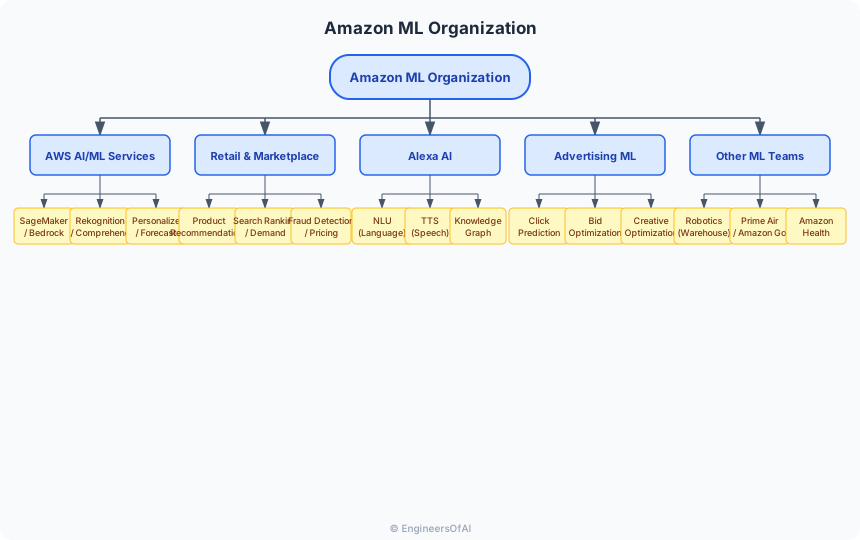
Team Comparison
| Dimension | AWS AI Services | Retail ML | Alexa AI | Advertising ML |
|---|---|---|---|---|
| Work type | Platform/tools for customers | Applied ML for internal products | Research + applied NLP | Applied ML at massive scale |
| Scale | Millions of external customers | 300M+ active customers | 500M+ Alexa devices | Billions of ad impressions/day |
| Research vs. engineering | 20/80 | 30/70 | 50/50 | 25/75 |
| Paper publishing | Uncommon | Occasional | Encouraged | Occasional |
| Pace | Fast product cycles | Very fast (weekly launches) | Medium (longer research cycles) | Very fast |
| Technical challenge | Multi-tenancy, API design | Scale, latency, diversity | NLU ambiguity, multi-turn | Real-time bidding, cold-start |
| Interview emphasis | System design, API thinking | Applied ML, business metrics | NLP depth, conversational AI | Ranking, optimization |
| Career growth | Clear IC + management tracks | Very promotion-friendly | Research-oriented growth | High-impact visibility |
AWS AI Services (especially Bedrock and SageMaker) is Amazon's fastest-growing ML area and is hiring aggressively. The interview emphasis for AWS roles tilts more toward system design and infrastructure compared to retail ML roles, which focus more on applied ML and business metrics.
Part 7 - Level Expectations
Amazon's Level System for ML Roles
| Level | Title | YoE (typical) | Scope | Interview Bar |
|---|---|---|---|---|
| L4 | SDE I / Applied Scientist I | 0-3 years | Well-defined tasks and components | Solid coding, ML fundamentals, basic LP stories |
| L5 | SDE II / Applied Scientist II | 3-7 years | Features and projects, some independence | Strong coding, ML depth, system design components, multiple LP stories |
| L6 | Senior SDE / Senior AS | 7-12 years | Large projects, tech leadership | Excellent system design, ML breadth + depth, strong LP stories with cross-team impact |
| L7 | Principal SDE / Principal AS | 12+ years | Org-wide direction | Industry-leading expertise, organizational influence, strategic LP stories |
Level-Specific Interview Calibration
L4 (Entry/Junior):
- Coding: Solve medium problems cleanly, hard problems with hints
- ML: Explain fundamentals clearly, implement basic algorithms
- LP: Show learning orientation, ownership of small projects
- System design: Not heavily tested, basic components
L5 (Mid-Level) - the most common ML interview level:
- Coding: Solve hard problems in 35-40 minutes
- ML: Deep expertise in 1-2 areas, practical experience deploying models
- LP: Stories showing project ownership, data-driven decisions, delivering results
- System design: Design complete ML systems, discuss trade-offs
L6 (Senior) - the bar increases significantly:
- Coding: Still tested, but weight shifts to design and leadership
- ML: Can drive technical strategy for an ML area
- LP: Stories showing cross-team influence, mentoring, organizational impact
- System design: Architect systems that multiple teams depend on
L7 (Principal) - rare and extremely competitive:
- Technical vision that shapes Amazon's ML direction
- Published thought leadership or patents
- LP stories showing company-wide impact
- Can discuss ML strategy at VP level
Amazon is one of the easier Big Tech companies to get leveled correctly at L5. If you have 4-6 years of ML experience and strong LP stories, target L5 directly. L6 is a significant jump - you need clear evidence of tech leadership and cross-team impact.
Part 8 - Compensation
Amazon's Back-Loaded RSU Structure
Amazon's compensation structure is unique and widely misunderstood. The key detail is the vesting schedule.
Amazon RSU vesting schedule:
- Year 1: 5%
- Year 2: 15%
- Year 3: 40%
- Year 4: 40%
This is dramatically back-loaded compared to the standard 25/25/25/25 at Google, Meta, or Microsoft.
2025/2026 Amazon ML Compensation (US)
| Level | Base Salary | RSU (4-Year Total) | Signing Bonus (Y1+Y2) | Total Comp Year 1 | Total Comp Year 3 |
|---|---|---|---|---|---|
| L4 | $130-165K | $80-160K | $20-50K | $175-250K | $200-280K |
| L5 | $155-195K | $200-400K | $50-100K | $250-375K | $350-450K |
| L6 | $185-230K | $400-800K | $80-150K | $350-500K | $550-750K |
| L7 | $220-280K | $800K-2M+ | $100-200K | $450-650K | $800K-1.2M+ |
Critical compensation details:
-
Base salary cap: Amazon famously caps base salary at approximately 350K for senior roles in recent years). The cap pushes compensation toward stock.
-
Signing bonus fills the gap: Because RSUs barely vest in Years 1-2, Amazon gives large signing bonuses (paid in Year 1 and Year 2 installments) to bridge the gap.
-
Year 3 cliff: Your total compensation jumps dramatically in Year 3 when 40% of your RSUs vest. Many Amazonians mentally commit to staying at least 3 years.
-
Stock appreciation matters enormously: If Amazon stock rises 30% during your tenure, your Year 3-4 compensation increases proportionally. The reverse is also true.
-
Refresher grants: Starting around your 1-year mark, you receive additional RSU grants that vest over 2 years - smoothing out compensation after the initial 4-year grant.

Negotiation Tips for Amazon
- Negotiate the RSU grant, not just base - the 4-year RSU total is highly negotiable with competing offers
- Signing bonus is flexible - if they cannot increase RSUs, ask for a larger signing bonus to bridge Years 1-2
- Competing offers matter enormously - Amazon recruiters have explicit authority to match or beat offers from Google, Meta, and top startups
- Level is the biggest lever - L5 to L6 is a $200K+ annual difference at steady-state
- Ask about refresher history - some teams give generous refreshers, others do not; this affects Years 3+ significantly
- Consider stock trajectory - if you are bullish on Amazon stock, the back-loaded structure works in your favor
Many candidates compare Amazon Year 1 compensation to Google or Meta Year 1 compensation and conclude Amazon pays less. This is misleading. At steady-state (Years 3-4 with refreshers), Amazon compensation is competitive. However, if you are likely to leave within 2 years, Amazon's back-loaded structure genuinely pays less than front-loaded competitors. Factor your expected tenure into the decision.
Part 9 - The Amazon Debrief Process
How Hiring Decisions Are Made
After your interview loop, all interviewers meet (usually the same day or next day) for a structured debrief.
Debrief structure:
- Each interviewer presents their evaluation independently (written before the meeting)
- Evaluations are shared simultaneously to avoid anchoring bias
- Each interviewer rates: Inclined (hire) or Not Inclined (do not hire) with LP-specific scores
- The Bar Raiser facilitates discussion on disagreements
- The Bar Raiser has veto power - if they say "Not Inclined," it is extremely difficult to override
Scoring criteria:
| Rating | Meaning |
|---|---|
| Strong Inclined | Exceeds the bar for this level - clear hire |
| Inclined | Meets the bar - hire |
| Not Inclined | Does not meet the bar - do not hire |
| Strong Not Inclined | Significantly below the bar - clear no |
Decision scenarios:
| Scenario | Likely Outcome |
|---|---|
| All Inclined, BR Inclined | Hire |
| Mix of Inclined/Not Inclined, BR Inclined | Usually hire (BR carries weight) |
| Most Inclined, BR Not Inclined | Usually no hire (BR veto) |
| All Not Inclined | No hire |
Unlike Google's hiring committee (which reviews written feedback without meeting the interviewers), Amazon's debrief is a live meeting where interviewers discuss and debate. This means a strong advocate in the room can sometimes sway borderline cases. If one interviewer saw exceptional LP alignment that others missed, they can argue for it.
Part 10 - Amazon-Specific Preparation Strategies
The 4-Week Amazon Prep Plan
Week 1: Leadership Principles Mastery
- Write 12 STAR stories (1 per major LP)
- Each story: 3 minutes max, quantifiable result, lesson learned
- Practice with a friend who asks follow-up questions
- Map each story to 2-3 LPs (stories should be reusable)
Week 2: Coding and ML Fundamentals
- Solve 50 Amazon-tagged LeetCode problems (medium + hard)
- Focus on: arrays, trees, graphs, dynamic programming
- Practice 5 ML implementation problems (gradient descent, k-means, decision trees from scratch)
- Time yourself: 40 minutes per problem
Week 3: ML System Design
- Practice 5 Amazon-relevant system design problems
- Focus on: recommendations, fraud detection, demand forecasting, search ranking
- Use the Amazon framework: customer impact, cost awareness, operational excellence
- Practice explaining trade-offs out loud
Week 4: Integration and Mock Interviews
- 2 full mock interview loops (coding + ML + system design + LP behavioral)
- Interleave LP questions into technical rounds (mirror Amazon's format)
- Research your target team
- Prepare questions for the hiring manager
- Review your STAR stories one final time
LP-to-Story Mapping Worksheet
Prepare your stories using this mapping:
| LP Cluster | Stories Needed | Example Scenario |
|---|---|---|
| Customer Obsession + Deliver Results | 2 stories | Shipped ML feature that improved customer metric |
| Ownership + Dive Deep | 2 stories | Debugged production ML issue, found root cause |
| Invent and Simplify + Think Big | 2 stories | Proposed novel ML approach that simplified architecture |
| Bias for Action + Insist on Highest Standards | 2 stories | Launched imperfect MVP, then iterated to excellence |
| Earn Trust + Have Backbone | 2 stories | Disagreed with senior person, backed by data |
| Learn and Be Curious + Hire and Develop | 2 stories | Learned new ML technique, mentored teammates |
Amazon-Specific Coding Tips
- Think about Amazon-scale data - mention how your solution handles millions of products, users, transactions
- Mention operational aspects - "How would we monitor this in production? What happens when it fails?"
- Optimize for cost - a cheaper solution that meets the bar is better than an expensive optimal solution
- Write clean, production-quality code - comments, error handling, meaningful variable names
- Discuss testing - "I would unit test this with edge cases X, Y, Z"
Amazon-Specific System Design Tips
- Start with the customer - "Who is the customer? What problem are we solving for them?"
- Define success metrics early - both business metrics and ML metrics
- Discuss cost explicitly - GPU costs, data storage costs, operational costs
- Include an operational plan - monitoring, alerting, runbooks, on-call
- Propose a simple baseline first - then add complexity incrementally
- Mention Amazon services - SageMaker, DynamoDB, Kinesis, S3 show awareness
Part 11 - Common Mistakes and How to Avoid Them
The Top 10 Amazon ML Interview Mistakes
| Mistake | Why It Happens | How to Avoid |
|---|---|---|
| 1. Weak LP stories | Not preparing enough stories | Write 12 stories, practice each 3 times |
| 2. No quantifiable results | Not thinking in data | Add numbers to every story, estimate if necessary |
| 3. "We" instead of "I" | Habit from team environments | Practice saying "I" - describe your specific contribution |
| 4. Over-engineering solutions | Wanting to impress | Start simple, add complexity only when justified |
| 5. Ignoring cost | Coming from academia or research | Include cost analysis in every system design |
| 6. Not connecting ML to business | Pure technical thinking | Every ML metric should map to a business metric |
| 7. Dismissing the Bar Raiser | Thinking "it's just behavioral" | The BR has veto power - take every LP question seriously |
| 8. Not asking about the team | Nervousness, time pressure | Prepare 3 questions for each interviewer |
| 9. Complaining about previous employers | Frustration | Focus on what you did, not what others did wrong |
| 10. Not knowing Amazon products | Assuming it doesn't matter | Use Amazon products critically - find ML applications |
What Ex-Amazon Interviewers Say
"The single biggest differentiator at Amazon is Leadership Principles. I have seen technically brilliant candidates get rejected because they could not tell a convincing story about a time they dove deep to find a root cause. And I have seen average technical candidates get hired because every story demonstrated ownership and customer obsession."
"When I interview for Applied Scientist, I spend 50% of my evaluation on whether the candidate can connect their ML work to business outcomes. Can they explain why the model matters to the customer? That is what Amazon values."
"The Bar Raiser process works. I have vetoed candidates that the hiring team loved because the candidate showed a pattern of taking credit for team work and not being able to describe what they personally contributed. At Amazon, ownership means you can explain exactly what you did and why."
Part 12 - The Amazon ML Interview Preparation Checklist
4 Weeks Out
- Write 12 STAR stories mapped to Leadership Principles
- Solve 50 Amazon-tagged LeetCode problems
- Practice 5 ML system design problems with Amazon framing
- Research 3-5 Amazon ML teams that interest you
- Read Amazon's ML blog and recent product launches
- Understand the RSU back-loading structure and your compensation expectations
1 Week Out
- Do 2 full mock interviews with LP integration in technical rounds
- Review your weakest LP stories and improve them
- Prepare 3 questions per round for interviewers
- Review your target team's recent projects and publications
- Practice explaining your ML projects in 3 minutes with quantified results
Day Before
- Light review - reread your STAR stories, do not cram technical material
- Prepare what you will wear (Amazon is casual, but neat)
- Set multiple alarms
- Review your key numbers (project metrics, impact data)
- Get 8 hours of sleep
Day Of
- Arrive 15 minutes early
- Bring water and a snack
- Remember: every round tests LPs - even the coding round
- Use breaks between rounds to reset mentally
- After each round, briefly note which LPs were discussed (helps with debrief prep if they ask for additional information)
- Thank each interviewer and ask genuine questions
Part 13 - Sample Questions and Answers
Behavioral (LP) Sample
Question (Customer Obsession): "Tell me about a time you made a decision based on customer data rather than your own intuition."
Strong answer:
S: "On our search ranking team, we were redesigning the product search algorithm. My intuition said we should prioritize relevance score, but customer behavior data told a different story."
T: "I was responsible for the ranking model that served 15M daily searches."
A: "I pulled 6 months of click-stream data and ran a cohort analysis. The data showed that customers who saw price and reviews prominently in initial results had 23% higher purchase conversion than those shown the most 'relevant' results. I proposed a multi-objective ranking model that balanced relevance, price sensitivity, and review quality. I ran an A/B test for 2 weeks with 5% of traffic, then expanded to 20% after validating the results. I also instrumented customer satisfaction surveys for both cohorts."
R: "Purchase conversion improved by 18%, and customer satisfaction scores remained flat - meaning customers were buying more without feeling manipulated. The model became the default ranker. What I learned is that customer behavior data can reveal preferences that even customers themselves cannot articulate."
System Design Sample
Question: "Design a demand forecasting system for Amazon's warehouse inventory."
Framework application:
- Customer impact: Accurate forecasting means products are in stock when customers want them (fewer "out of stock" experiences) and less capital tied up in excess inventory.
- Data: Historical sales data, seasonal trends, promotional calendar, weather data, competitor pricing, new product launches, web traffic patterns.
- Model: Hierarchical time series forecasting - global model captures macro trends, local models for product-category-warehouse granularity. DeepAR or temporal fusion transformer for capturing complex seasonality. Gradient boosted trees for short-term adjustments.
- Serving: Batch predictions (daily forecast for 30-day horizon), stored in DynamoDB. Real-time adjustments for flash sales or supply disruptions via streaming pipeline on Kinesis.
- Monitoring: MAPE per product category, stockout rate, overstock rate, inventory carrying cost. Alert on forecast drift (when actual deviates from predicted by >20% for 3 consecutive days).
- Cost optimization: Start with simple exponential smoothing baseline. Add complexity only where the lift justifies the compute cost. For 80% of products, the simple model is sufficient.
Next Steps
Amazon's Leadership Principle-driven interview process is unlike any other company in tech. Mastering the STAR format and connecting every answer - technical and behavioral - to the LPs is the single highest-leverage preparation you can do.
Next, learn how Apple's ML interviews differ - with their unique secrecy culture and emphasis on on-device ML: Apple ML Interviews.