
ML Fundamentals for Interviews - Your Complete Roadmap
Reading time: ~25 min | Interview relevance: Critical | Roles: MLE, AI Eng, Data Scientist, Research Engineer, MLOps
The Real Interview Moment
You are thirty minutes into a Google MLE phone screen. The interviewer has just finished asking you about your resume and shifts tone: "Let's talk fundamentals. You have a model that performs well on training data but poorly on validation. Walk me through your entire debugging process." You freeze - not because you do not know what overfitting is, but because you are unsure where to start. Do you talk about bias-variance? Regularization? Loss functions? Evaluation metrics? The silence stretches.
This is the moment that separates candidates who studied ML fundamentals as isolated topics from those who understand them as an interconnected system. The interviewer is not looking for a single keyword - they want to see you systematically navigate a web of concepts: diagnose with evaluation metrics, reason about the root cause with bias-variance analysis, and prescribe solutions using regularization and optimization techniques.
This section gives you that interconnected understanding. Twelve topics, organized in dependency order, with the exact depth required for each interview round at every major company.
What You Will Master
After completing this section, you will be able to:
- Diagnose model failures by decomposing errors into bias, variance, and irreducible noise
- Select and justify loss functions for any problem type - regression, classification, ranking, and contrastive learning
- Apply the right regularization technique given a model architecture and failure mode
- Explain optimization algorithms from SGD through Adam, including convergence guarantees and practical tuning
- Choose evaluation metrics that align with business objectives, not just mathematical convenience
- Design feature engineering pipelines that handle missing data, categorical variables, and feature interactions
- Build and explain ensemble methods - bagging, boosting, and stacking - with mathematical precision
- Implement proper cross-validation strategies for time series, grouped data, and imbalanced datasets
- Handle class imbalance at the data level, algorithm level, and evaluation level
- Apply dimensionality reduction and explain when PCA, t-SNE, or UMAP is appropriate
- Reason about probabilistic ML - Bayesian inference, graphical models, and uncertainty quantification
- Answer rapid-fire ML fundamentals questions under time pressure with structured, concise responses
Self-Assessment: Where Are You Now?
Rate yourself honestly on each topic before you begin. Return after completing the section to measure progress.
| # | Topic | 1 - Never Seen | 2 - Vaguely Familiar | 3 - Can Explain | 4 - Can Derive | 5 - Can Teach | Your Score |
|---|---|---|---|---|---|---|---|
| 1 | Bias-Variance Tradeoff | Cannot define | Know the terms | Can explain with examples | Can do the decomposition proof | Can connect to model selection | ___ |
| 2 | Loss Functions | Cannot name any | Know MSE and cross-entropy | Can explain 5+ losses | Can derive gradients | Can design custom losses | ___ |
| 3 | Regularization | Cannot define | Know L1/L2 exist | Can explain why they work | Can derive sparsity from L1 | Can design regularization strategy | ___ |
| 4 | Optimization | Know "gradient descent" | Can explain SGD | Can compare SGD/Adam/RMSProp | Can derive update rules | Can debug training instabilities | ___ |
| 5 | Evaluation Metrics | Know accuracy | Know precision/recall | Can explain AUC-ROC | Can connect metrics to business | Can design custom metrics | ___ |
| 6 | Feature Engineering | Know one-hot encoding | Can handle basic features | Can design feature pipelines | Can handle complex interactions | Can automate feature discovery | ___ |
| 7 | Ensemble Methods | Know "random forest" | Can explain bagging vs boosting | Can derive bias-variance reduction | Can implement from scratch | Can design custom ensembles | ___ |
| 8 | Cross-Validation | Know train/test split | Can explain k-fold | Can handle special cases | Can implement stratified/grouped CV | Can design CV for production | ___ |
| 9 | Handling Imbalance | Know "more data" | Can explain oversampling | Can compare 5+ techniques | Can connect to loss and metrics | Can design end-to-end strategy | ___ |
| 10 | Dimensionality Reduction | Know PCA exists | Can explain PCA steps | Can compare PCA/t-SNE/UMAP | Can derive PCA from SVD | Can choose method for task | ___ |
| 11 | Probabilistic ML | Know Bayes' theorem | Can explain MAP vs MLE | Can describe graphical models | Can derive posterior updates | Can design Bayesian pipelines | ___ |
| 12 | ML Interview Questions | Cannot answer quickly | Can answer some | Can handle most | Can answer all within time | Can evaluate others' answers | ___ |
- <20 total: Start from Topic 1 and work through sequentially. Budget 4-6 weeks.
- 20-35 total: You have foundations. Focus on topics scoring <3. Budget 2-3 weeks.
- 36-50 total: Strong base. Focus on derivations and practice problems. Budget 1-2 weeks.
- 50+ total: Review mode. Do practice problems and mock interviews. Budget 3-5 days.
Topic Dependency Map
Not all topics are equally foundational. Some must be learned before others make sense. This diagram shows the prerequisite relationships:
 class PROB,MIQ capstone
**Legend:**
- Blue (Foundation) - Start here. No prerequisites.
- Yellow (Core) - Require 1-2 foundation topics.
- Green (Advanced) - Require multiple core topics.
- Purple (Capstone) - Integrate everything.
## Recommended Study Orders
### Path A: The Sequential Scholar (4-6 weeks)
Best if you are starting from scratch or scored <20 on the self-assessment.
| Week | Topics | Hours/Day | Focus |
|------|--------|-----------|-------|
| 1 | Bias-Variance, Loss Functions | 1.5-2h | Definitions, intuition, basic math |
| 2 | Regularization, Optimization | 1.5-2h | Mathematical derivations, connections to Week 1 |
| 3 | Evaluation Metrics, Feature Engineering | 1.5-2h | Practical application, business context |
| 4 | Ensemble Methods, Cross-Validation | 1.5-2h | Combining everything learned so far |
| 5 | Handling Imbalance, Dimensionality Reduction | 1.5-2h | Special cases and advanced techniques |
| 6 | Probabilistic ML, Interview Questions | 1.5-2h | Integration and rapid-fire practice |
### Path B: The Targeted Sprinter (2-3 weeks)
Best if you have foundations but need to sharpen specific areas. Scored 20-35 on the self-assessment.
| Week | Focus | Strategy |
|------|-------|----------|
| 1 | Topics where you scored <3 | Deep study with derivations |
| 2 | Topics where you scored 3 | Practice problems and connections |
| 3 | Full practice sets | Timed mock interview questions |
### Path C: The Interview-Ready Reviewer (3-5 days)
Best if you scored 36+ and have interviews within a week.
| Day | Focus |
|-----|-------|
| 1 | Review all Interview Cheat Sheets across 12 topics |
| 2 | Do all Practice Problems under timed conditions |
| 3 | Mock interview: answer each "60-Second Answer" out loud |
| 4-5 | Focus on any topic where you stumbled |
## Topic-to-Interview-Round Mapping
Different interview rounds test different topics at different depths. This table maps each topic to the rounds where it appears:
| Topic | Phone Screen | ML Depth | System Design | Coding | Behavioral |
|-------|:----------:|:--------:|:------------:|:------:|:----------:|
| Bias-Variance | Deep | Deep | Mentioned | - | - |
| Loss Functions | Medium | Deep | Medium | Sometimes | - |
| Regularization | Medium | Deep | Medium | - | - |
| Optimization | Light | Deep | Medium | Sometimes | - |
| Evaluation Metrics | Medium | Deep | Deep | Sometimes | Light |
| Feature Engineering | Light | Medium | Deep | Medium | - |
| Ensemble Methods | Medium | Deep | Medium | Sometimes | - |
| Cross-Validation | Medium | Medium | Light | Sometimes | - |
| Handling Imbalance | Medium | Deep | Medium | - | Light |
| Dimensionality Reduction | Light | Medium | Light | Sometimes | - |
| Probabilistic ML | Light | Deep | Light | - | - |
| ML Interview Questions | Deep | Light | - | - | - |
:::tip[Interviewer's Perspective]
Phone screens test breadth - can you speak intelligently about 8+ topics in 45 minutes? ML depth rounds test derivation ability on 2-3 topics over 60 minutes. System design rounds test whether you can apply these concepts to real problems. Prioritize accordingly.
:::
## Company-Specific Topic Frequency
Based on interview reports and preparation guides, here is how frequently each topic appears at major companies:
### Google (L4/L5 MLE)
| Topic | Frequency | Typical Question Style |
|-------|:---------:|------------------------|
| Bias-Variance | Very High | "Derive the decomposition. How does it inform model selection?" |
| Loss Functions | Very High | "Design a loss function for this specific problem." |
| Regularization | High | "Why does L1 induce sparsity? Prove it geometrically." |
| Optimization | Very High | "Compare Adam vs SGD. When would you choose each?" |
| Evaluation Metrics | Very High | "Our model has 99% accuracy. Is it good? Why or why not?" |
| Ensemble Methods | Medium | "Explain gradient boosting. How does it reduce bias?" |
| Probabilistic ML | Medium | "Describe a Bayesian approach to this problem." |
### Meta (ML Engineer)
| Topic | Frequency | Typical Question Style |
|-------|:---------:|------------------------|
| Loss Functions | Very High | "We use cross-entropy for News Feed ranking. Why? What alternatives?" |
| Evaluation Metrics | Very High | "Design metrics for integrity/misinformation detection." |
| Feature Engineering | Very High | "How would you engineer features from user interaction data?" |
| Handling Imbalance | High | "1% of posts are policy-violating. How do you train a classifier?" |
| Ensemble Methods | High | "We use GBDT for many models. Explain why." |
| Cross-Validation | Medium | "How do you validate a model when data has temporal dependence?" |
### Amazon (Applied Scientist)
| Topic | Frequency | Typical Question Style |
|-------|:---------:|------------------------|
| Evaluation Metrics | Very High | "Define a metric that captures customer satisfaction for recommendations." |
| Feature Engineering | Very High | "What features would you build for demand forecasting?" |
| Ensemble Methods | High | "How would you combine multiple models for product search?" |
| Handling Imbalance | High | "Fraud is 0.1% of transactions. Walk me through your approach." |
| Cross-Validation | High | "How do you validate a time-series forecasting model?" |
| Bias-Variance | Medium | "Your model is underfitting. What do you try?" |
### OpenAI / Anthropic (Research Engineer)
| Topic | Frequency | Typical Question Style |
|-------|:---------:|------------------------|
| Loss Functions | Very High | "Derive the RLHF loss. What assumptions does it make?" |
| Optimization | Very High | "Why does Adam work well for transformers? Limitations?" |
| Regularization | High | "How does dropout relate to Bayesian approximation?" |
| Probabilistic ML | High | "Describe uncertainty quantification in large language models." |
| Bias-Variance | Medium | "How does the bias-variance tradeoff apply to overparameterized models?" |
| Dimensionality Reduction | Medium | "How would you analyze the representation space of a model?" |
### Startups (Generalist ML)
| Topic | Frequency | Typical Question Style |
|-------|:---------:|------------------------|
| All fundamentals | High | "You have 10K labeled examples and a business problem. Walk me through everything." |
| Feature Engineering | Very High | "We have raw logs. How do you go from here to a model?" |
| Evaluation Metrics | Very High | "How do we know if the model is working? Define success." |
| Cross-Validation | High | "We have limited data. How do you validate reliably?" |
| Handling Imbalance | High | "Our positive class is 2%. What do you do?" |
:::note[Company Variation]
Startups test breadth over depth. They want to know you can own the entire ML pipeline. Big tech tests depth on specific topics because they have specialized teams. Research labs test mathematical rigor and first-principles thinking.
:::
## The 12 Topics at a Glance
### Tier 1 - Foundation (Start Here)
#### [1. Bias-Variance Tradeoff](./Bias-Variance)
The single most important conceptual framework in ML. Every model selection decision, every hyperparameter choice, every debugging session implicitly involves bias-variance reasoning. If you cannot explain this clearly and derive the decomposition, you will struggle in every ML interview.
**Key deliverable:** Be able to draw the bias-variance-complexity curve on a whiteboard and explain every region.
**What you will learn:**
- Mathematical decomposition: EPE = Bias^2 + Variance + Irreducible Noise
- The add-and-subtract E[f_hat] derivation trick
- How to diagnose bias vs variance from learning curves
- Double descent in overparameterized models
- How bias-variance connects to regularization, ensembles, and model selection
**Sample interview exchange:**
> **Interviewer:** "Your neural network has 99% training accuracy and 72% test accuracy. What is happening?"
> **Strong answer:** "The large train-test gap indicates high variance - the model is overfitting. I would verify with learning curves: if adding more training data improves test accuracy, that confirms high variance. Solutions in priority order: (1) regularization - dropout 0.3-0.5, weight decay, (2) data augmentation, (3) simpler architecture, (4) early stopping."
#### [2. Loss Functions](./Loss-Functions)
The bridge between "what we want" and "what the optimizer does." Loss function choice affects convergence, robustness, and model behavior in ways that most candidates cannot articulate. Top candidates can design custom losses.
**Key deliverable:** Given any ML problem description, be able to recommend and justify a loss function within 30 seconds.
**What you will learn:**
- MSE, MAE, Huber for regression - when each is appropriate
- Cross-entropy derivation from Maximum Likelihood Estimation
- Hinge loss and margin-based learning (SVMs)
- Focal loss for extreme class imbalance
- Contrastive loss, triplet loss, and InfoNCE for metric learning
- Custom loss function design from first principles
**Sample interview exchange:**
> **Interviewer:** "We are training a fraud detection model. Only 0.1% of transactions are fraudulent. What loss function?"
> **Strong answer:** "Binary cross-entropy with class weights as a baseline - weight the positive class by 1000:1. If the model still overwhelms with easy negatives, switch to focal loss with gamma=2, which downweights easy-to-classify legitimate transactions and focuses gradient signal on ambiguous cases. I would also consider asymmetric weighting - false negatives (missed fraud) should cost more than false positives (flagged legitimate transactions)."
### Tier 2 - Core (Requires Tier 1)
#### [3. Regularization](./Regularization)
The primary defense against overfitting and the topic with the richest mathematical depth in fundamentals interviews. Understanding why L1 produces sparsity (not just that it does) separates strong hires from lean hires.
**Key deliverable:** Explain L1 sparsity using both the geometric argument and the subgradient argument.
**What you will learn:**
- L1 (Lasso), L2 (Ridge), and Elastic Net with mathematical derivations
- Why L1's diamond constraint creates sparsity at corners - and the subgradient proof
- Dropout as ensemble averaging, co-adaptation prevention, and approximate Bayesian inference
- Batch normalization's hidden regularization effect
- Early stopping's equivalence to L2 regularization
- Why weight decay differs from L2 for Adam (and why AdamW exists)
**Sample interview exchange:**
> **Interviewer:** "Why does L1 produce sparse weights?"
> **Strong answer:** "Two explanations. Geometrically: L1's constraint region is a diamond with corners on the axes. The loss contours (ellipses) are most likely to be tangent to the diamond at a corner, where one or more weights are exactly zero - the circle of L2 has no corners, so this does not happen. Mathematically: the subgradient of |w| at w=0 is the interval [-1, 1]. The optimality condition at w=0 requires |gradient of data loss| <= lambda. So any feature whose data gradient is smaller than lambda stays at exactly zero."
#### [4. Optimization](./Optimization)
Every ML model is trained by an optimizer, yet most candidates cannot explain why Adam uses both first and second moment estimates. Optimization questions reveal whether you understand the training process or just call `model.fit()`.
**Key deliverable:** Derive the Adam update rule and explain each component's purpose.
**What you will learn:**
- SGD, momentum, RMSProp, Adam, and AdamW update rules
- Learning rate schedules: warmup, cosine annealing, step decay
- Convergence theory: convex vs non-convex, saddle points, local minima
- Gradient clipping and its role in preventing training instabilities
- Practical tuning: learning rate finders, batch size effects
#### [5. Evaluation Metrics](./Evaluation-Metrics)
The topic that connects ML to business value. Interviewers use metrics questions to test whether you can think beyond accuracy and connect model performance to real-world impact.
**Key deliverable:** Given a business problem, define an evaluation metric, explain its failure modes, and propose alternatives.
**What you will learn:**
- Accuracy, precision, recall, F1, and when each is appropriate
- AUC-ROC vs AUC-PR - and why they tell different stories on imbalanced data
- Calibration: reliability diagrams, Brier score, expected calibration error
- Ranking metrics: NDCG, MAP, MRR
- Business metric alignment: connecting ML metrics to revenue, engagement, safety
#### [6. Feature Engineering](./Feature-Engineering)
The most practically important skill for production ML. At most companies, better features beat better models. Feature engineering questions test your ability to think creatively about data.
**Key deliverable:** Given a raw dataset description, design a feature engineering pipeline in 5 minutes.
**What you will learn:**
- Handling categorical features: one-hot, target encoding, hashing, embeddings
- Numerical transformations: log, power, binning, normalization
- Missing data strategies: imputation, indicator features, model-based approaches
- Feature interactions and polynomial features
- Time-based features: lags, rolling windows, cyclical encoding
- Text and image feature extraction for tabular models
### Tier 3 - Advanced (Requires Tier 2)
#### [7. Ensemble Methods](./Ensemble-Methods)
Bagging reduces variance. Boosting reduces bias. Stacking combines strengths. These three sentences take 10 seconds to say and 60 minutes to properly explain. Ensemble questions test the depth of your understanding of Tier 1 and 2 concepts.
**Key deliverable:** Explain why random forests reduce variance using the bias-variance decomposition.
**What you will learn:**
- Bagging: bootstrap aggregating, variance reduction proof, out-of-bag estimation
- Random Forests: feature randomization, why it decorrelates trees
- Boosting: AdaBoost, Gradient Boosting, XGBoost, LightGBM, CatBoost
- Stacking: meta-learners, blending, when stacking helps vs hurts
- Practical guidance: when to use GBDT vs neural networks vs linear models
#### [8. Cross-Validation](./Cross-Validation)
Simple in concept, subtle in practice. Time-series CV, grouped CV, nested CV, and stratified CV each exist because naive k-fold fails in specific situations. Interviewers test whether you know when the standard approach breaks.
**Key deliverable:** Given a dataset with temporal dependence and groups, design a proper validation strategy.
**What you will learn:**
- k-fold, stratified k-fold, leave-one-out, repeated k-fold
- Time-series CV: expanding window, sliding window
- Grouped CV: when observations are not independent (e.g., multiple samples per patient)
- Nested CV: for simultaneous hyperparameter tuning and performance estimation
- Common pitfalls: data leakage, information leakage through preprocessing
#### [9. Handling Imbalance](./Handling-Imbalance)
Nearly every real-world problem has imbalanced classes. This topic integrates loss functions, evaluation metrics, and data processing into a coherent strategy. It is the most common "applied ML" interview question.
**Key deliverable:** Present a complete strategy for a 99:1 imbalanced classification problem.
**What you will learn:**
- Data-level: oversampling (random, SMOTE, ADASYN), undersampling, hybrid approaches
- Algorithm-level: class weights, focal loss, cost-sensitive learning
- Evaluation-level: AUC-PR, F-beta, cost matrices, threshold tuning
- When to do nothing: sometimes the imbalance is the point (e.g., anomaly detection)
#### [10. Dimensionality Reduction](./Dimensionality-Reduction)
PCA, t-SNE, UMAP, autoencoders - each serves a different purpose. Interviewers test whether you can match the technique to the task and explain the mathematical foundations.
**Key deliverable:** Derive PCA from the maximum variance perspective and explain why t-SNE cannot be used for new data points.
**What you will learn:**
- PCA: eigenvectors, eigenvalues, variance explained, connection to SVD
- t-SNE: perplexity, KL divergence, why it only preserves local structure
- UMAP: topological data analysis, advantages over t-SNE
- Autoencoders: bottleneck architecture, variational autoencoders
- Practical guidance: preprocessing before PCA, choosing number of components
### Tier 4 - Capstone (Integrates Everything)
#### [11. Probabilistic ML](./Probabilistic-ML)
Bayesian inference, graphical models, and uncertainty quantification. This is the most mathematically demanding topic and the one that separates research-track candidates from applied-track candidates.
**Key deliverable:** Derive the posterior for Bayesian linear regression and explain when a Bayesian approach is worth the computational cost.
**What you will learn:**
- Bayes' theorem applied to ML: prior, likelihood, posterior, evidence
- MLE vs MAP vs full Bayesian inference
- Conjugate priors and their role in tractable inference
- Graphical models: directed (Bayesian networks) and undirected (MRFs)
- Approximate inference: MCMC, variational inference
- Uncertainty quantification: aleatoric vs epistemic uncertainty
#### [12. ML Interview Questions](./ML-Interview-Questions)
Rapid-fire questions that integrate all 11 previous topics. This is your final test - can you apply everything you have learned under time pressure?
**Key deliverable:** Answer 20 ML fundamentals questions in 30 minutes, each with structured 60-second responses.
**What you will learn:**
- The 60-second answer framework: State → Explain → Example → Trade-off
- 50+ curated questions with strong-hire answers
- Timing strategies: when to go deep vs when to stay broad
- How to handle "I don't know" gracefully
- Follow-up question patterns and how to anticipate them
## Rapid-Fire Warm-Up Quiz
Before diving into the topics, test your current knowledge with these 12 questions - one per topic. You should be able to answer each in 60 seconds or less after completing this section.
| # | Question | Topic Being Tested |
|---|----------|-------------------|
| 1 | "Decompose expected prediction error into three terms and explain each." | Bias-Variance |
| 2 | "Why does cross-entropy work better than MSE for classification?" | Loss Functions |
| 3 | "Why does L1 regularization produce sparse weights but L2 does not?" | Regularization |
| 4 | "Explain why Adam uses both first and second moment estimates." | Optimization |
| 5 | "When is AUC-ROC misleading? What do you use instead?" | Evaluation Metrics |
| 6 | "How do you handle a categorical feature with 10,000 unique values?" | Feature Engineering |
| 7 | "Why does bagging reduce variance but not bias?" | Ensemble Methods |
| 8 | "Why can you not use standard k-fold CV on time-series data?" | Cross-Validation |
| 9 | "You have a 99:1 class imbalance. Walk me through your approach." | Handling Imbalance |
| 10 | "When would you use t-SNE vs PCA? Can t-SNE be used on new data points?" | Dimensionality Reduction |
| 11 | "Explain the difference between MLE and MAP estimation." | Probabilistic ML |
| 12 | "Your model has high training accuracy but low test accuracy. Diagnose and fix." | ML Interview Questions |
:::tip[Interviewer's Perspective]
These 12 questions are the exact style of "warm-up" questions that interviewers use in the first 10-15 minutes of an ML fundamentals round. They are testing breadth - can you speak intelligently about all 12 topics? If you stumble on more than 2, the interviewer may conclude you have gaps in fundamentals and shift to probing those gaps for the remaining time.
:::
<details>
<summary>Click to reveal benchmark answers</summary>
**Q1 - Bias-Variance:** "Expected prediction error decomposes into bias squared, variance, and irreducible noise. Bias is the error from the model's simplifying assumptions - a linear model has high bias for non-linear data. Variance is how much predictions change across different training sets - a deep tree has high variance. Irreducible noise is the inherent randomness in the data that no model can eliminate."
**Q2 - Loss Functions:** "MSE treats classification outputs as continuous values, producing gradients that are small when the prediction is confidently wrong (plateau region of sigmoid). Cross-entropy produces large gradients for confident wrong predictions because it penalizes via log(p), which approaches infinity as p approaches 0. This means the model corrects its worst mistakes fastest."
**Q3 - Regularization:** "L1's constraint region is a diamond with corners on the axes. Loss contours (ellipses) are most likely to touch the diamond at a corner, where one or more weights equal zero. L2's constraint region is a smooth circle with no corners, so the tangent point almost never has exact zeros. Mathematically, the subgradient of |w| at w=0 is the interval [-1,1], creating a dead zone where the data gradient must exceed lambda to move the weight away from zero."
**Q4 - Optimization:** "The first moment estimate (m) tracks the exponential moving average of gradients, providing momentum - it smooths gradient noise and accelerates movement in consistent directions. The second moment estimate (v) tracks the exponential moving average of squared gradients, providing per-parameter learning rates - parameters with historically large gradients get smaller updates, and vice versa. Together, they provide both adaptive learning rates and momentum."
**Q5 - Evaluation Metrics:** "AUC-ROC is misleading for highly imbalanced data because it includes the true negative rate, which is trivially high when negatives dominate. A model that predicts everything as negative has high TNR and thus inflated AUC-ROC. Use AUC-PR (precision-recall) instead, which focuses on how well the model identifies the rare positive class."
**Q6 - Feature Engineering:** "Options: (1) Target encoding - replace each category with the mean of the target for that category, with smoothing to prevent overfitting on rare categories. (2) Hashing trick - hash categories into a fixed number of bins. (3) Embedding layer - learn a dense representation if using a neural network. (4) Frequency encoding - replace with the count/frequency of each category. Never one-hot encode 10,000 categories - it creates a sparse, high-dimensional feature space."
**Q7 - Ensemble Methods:** "Bagging trains multiple models on bootstrap samples and averages their predictions. Averaging reduces variance because Var(mean) = Var(individual)/n (if independent). It does not reduce bias because each model has the same expected prediction - the average of unbiased estimators is unbiased, and the average of biased estimators retains the bias."
**Q8 - Cross-Validation:** "Standard k-fold randomly assigns data points to folds, which means future data can leak into training folds. For time series, you must use temporal splits where training data always precedes validation data. Use expanding-window or sliding-window CV, where fold k trains on data up to time t_k and validates on time t_k to $t_{k+1}$."
**Q9 - Handling Imbalance:** "Structured approach: (1) Use appropriate metrics - AUC-PR, F1, not accuracy. (2) At the algorithm level - class weights (1:99 ratio), focal loss if many easy negatives. (3) At the data level - SMOTE or random oversampling of the minority, if needed. (4) At the threshold level - tune the classification threshold using the precision-recall curve to match the business cost ratio."
**Q10 - Dimensionality Reduction:** "PCA for linear dimensionality reduction, preprocessing, and when you need to transform new data points (PCA is a linear projection). t-SNE for visualization only - it preserves local structure but distorts global structure, and it cannot be applied to new points (it requires re-running on the full dataset). Use UMAP for visualization with better global structure preservation and the ability to transform new points."
**Q11 - Probabilistic ML:** "MLE maximizes the likelihood P(data|theta) - it finds the parameters that make the observed data most probable. MAP maximizes P(theta|data) = P(data|theta) * P(theta) / P(data) - it also considers a prior P(theta) on the parameters. MAP with a Gaussian prior is equivalent to L2 regularization. MAP with a Laplacian prior is equivalent to L1 regularization. The key difference: MLE can overfit; MAP incorporates prior knowledge to regularize."
**Q12 - ML Interview Questions:** "Diagnose: high training accuracy + low test accuracy = high variance (overfitting). The model memorizes training data but does not generalize. Fixes, ranked: (1) Add regularization - dropout, weight decay, early stopping. (2) Get more training data or augment existing data. (3) Simplify the model - fewer parameters, shallower architecture. (4) Feature selection - remove noisy or irrelevant features. Verify with learning curves: the training-validation gap should shrink."
</details>
## Common Interview Patterns
Understanding how interviewers combine these topics helps you prepare for the interconnected nature of real interviews.
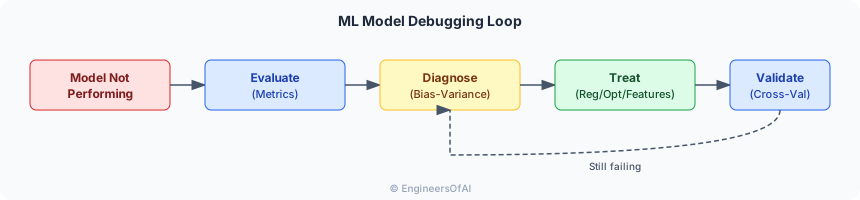
### Pattern 1: The Debugging Chain
The interviewer describes a model that is not working and asks you to debug it. This chains together multiple topics:
1. **Evaluate** (Evaluation Metrics) - "What metrics are you using? Are they appropriate?"
2. **Diagnose** (Bias-Variance) - "Is this high bias or high variance?"
3. **Treat** (Regularization/Optimization/Features) - "What specific changes would you make?"
4. **Validate** (Cross-Validation) - "How would you know if your changes helped?"
### Pattern 2: The Design Trade-Off
The interviewer presents a system with constraints and asks you to make trade-offs:
"You have a real-time recommendation system. Latency budget is 50ms. Current model is a 10-layer neural network with 99.2% offline AUC but 200ms latency. How do you get it under 50ms without losing too much quality?"
This tests: Loss Functions (distillation loss), Regularization (pruning, quantization), Ensemble Methods (can you approximate the ensemble with a simpler model?), Dimensionality Reduction (reduce feature space), Evaluation Metrics (what quality metric matters at 50ms?).
### Pattern 3: The Imbalance Scenario
Nearly universal in applied ML interviews:
"We have [rare event - fraud, disease, system failure]. The positive class is [0.01-5%]. Walk me through your entire approach."
This chains: Handling Imbalance → Loss Functions (focal loss, class weights) → Evaluation Metrics (AUC-PR, not accuracy) → Cross-Validation (stratified) → Feature Engineering (domain-specific signals).
### Pattern 4: The First Principles Deep Dive
The interviewer picks one topic and goes deep:
"Derive [formula]. Now explain the assumptions. Now tell me when those assumptions fail. Now tell me what you would do differently."
This tests: mathematical rigor (can you derive?), critical thinking (what are the assumptions?), and practical judgment (what breaks in production?).
## How Each Topic Connects
Understanding ML fundamentals is not about memorizing 12 isolated topics. It is about seeing the connections:
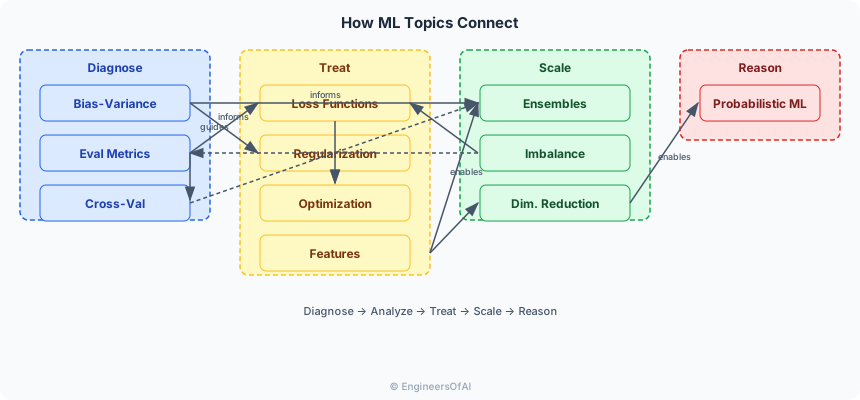
The pattern in every ML debugging session:
1. **Diagnose** - Use evaluation metrics and cross-validation to identify the problem
2. **Analyze** - Use bias-variance reasoning to understand the root cause
3. **Treat** - Apply the right combination of loss functions, regularization, optimization, and feature engineering
4. **Scale** - Use ensembles, imbalance handling, and dimensionality reduction to improve further
5. **Reason** - Use probabilistic thinking to quantify uncertainty and make decisions
:::tip[60-Second Answer]
When asked "Walk me through debugging a poorly performing model," use this exact framework: Diagnose (metrics + validation), Analyze (bias vs variance), Treat (loss + regularization + features + optimization), Scale (ensembles + imbalance handling), Reason (uncertainty). Interviewers love structured frameworks.
:::
## Interview Cheat Sheet - All Topics
| Topic | One-Liner | Key Formula | Instant Red Flag |
|-------|-----------|-------------|------------------|
| Bias-Variance | Error = Bias^2 + Variance + Noise | E[(f - f_hat)^2] decomposition | "Just use more data" without analysis |
| Loss Functions | Translates goals into gradients | Cross-entropy: -sum(y log p) | Cannot name more than MSE |
| Regularization | Constrains model complexity | L2: lambda * sum(w^2) | "Regularization prevents underfitting" |
| Optimization | Finds the best parameters | Adam: m/(1-beta1), v/(1-beta2) | "SGD and Adam are the same" |
| Eval Metrics | Measures what matters | F1 = 2PR/(P+R) | Using accuracy on imbalanced data |
| Feature Engineering | Better features > better models | Interaction: x1 * x2 | "The model handles raw features" |
| Ensemble Methods | Combine weak learners wisely | Bagging reduces variance by 1/n | "Ensembles always improve performance" |
| Cross-Validation | Honest performance estimation | k-fold: k train/val splits | Using future data to validate past |
| Handling Imbalance | Not all errors are equal | SMOTE, class weights, focal loss | "Just oversample the minority" |
| Dim Reduction | Compress without losing signal | PCA: maximize variance | "t-SNE preserves global structure" |
| Probabilistic ML | Quantify uncertainty | Bayes: P(theta\|D) proportional to P(D\|theta)P(theta) | "Bayesian = better" without justification |
| Interview Questions | Speed + structure + depth | 60-second answer framework | Rambling without structure |
## Spaced Repetition Checkpoints
Use these checkpoints to reinforce your learning over time. Each checkpoint should take 15-30 minutes.
### Day 0 - Initial Learning
- [ ] Read the topic page for your current focus area
- [ ] Complete the self-assessment for that topic
- [ ] Do at least one practice problem
### Day 3 - First Recall
- [ ] Without looking at notes, write down the key formula and one-liner for each topic studied
- [ ] Explain the topic to an imaginary interviewer (out loud, timed to 60 seconds)
- [ ] Review any gaps against the Interview Cheat Sheet
### Day 7 - Connections
- [ ] Draw the dependency diagram from memory
- [ ] For each topic studied, explain how it connects to 2 other topics
- [ ] Do one practice problem from each topic studied
### Day 14 - Application
- [ ] Given a mock scenario ("model overfits on tabular data with 100K rows"), walk through your complete debugging framework using all relevant topics
- [ ] Time yourself: you should be able to give a structured 3-minute answer
- [ ] Identify which topics you hesitate on - review those
### Day 21 - Mock Interview
- [ ] Have someone (or use a timer) ask you 10 rapid-fire ML fundamentals questions
- [ ] Each answer should be 60-90 seconds, structured, and include a formula or example
- [ ] Score yourself: Did you hit all key points? Were you concise? Did you show depth when probed?
:::warning[Common Trap]
Many candidates study ML fundamentals by re-reading notes. This creates an illusion of knowledge. Spaced retrieval - actively recalling information without looking - is 3-4x more effective for long-term retention. Use these checkpoints as active recall exercises, not passive review sessions.
:::
## Difficulty Calibration Guide
Not all topics require the same depth. This table maps each topic to the expected depth for different roles - use it to calibrate your preparation.
| Topic | MLE (Big Tech) | AI Engineer | Data Scientist | Research Engineer | MLOps |
|-------|:--------------:|:-----------:|:--------------:|:-----------------:|:-----:|
| Bias-Variance | Derive + Apply | Explain + Apply | Explain + Apply | Derive + Extend | Explain |
| Loss Functions | Derive + Design | Explain + Choose | Explain + Choose | Derive + Design | Know |
| Regularization | Derive + Apply | Explain + Apply | Explain + Apply | Derive + Extend | Know |
| Optimization | Derive + Tune | Explain + Tune | Know + Tune | Derive + Research | Know |
| Evaluation Metrics | Design + Align | Design + Align | Design + Align | Know + Apply | Monitor |
| Feature Engineering | Design + Build | Design + Build | Design + Build | Know | Pipeline |
| Ensemble Methods | Derive + Apply | Explain + Apply | Explain + Apply | Derive + Extend | Deploy |
| Cross-Validation | Design + Implement | Design + Implement | Design + Implement | Know + Apply | Pipeline |
| Handling Imbalance | Full Strategy | Full Strategy | Full Strategy | Know + Apply | Monitor |
| Dim Reduction | Derive + Apply | Explain + Apply | Derive + Apply | Derive + Research | Know |
| Probabilistic ML | Explain + Apply | Know | Derive + Apply | Derive + Research | Know |
| Interview Questions | All of the above | All of the above | All of the above | All of the above | Relevant subset |
**Legend:**
- **Know** - Can define and explain the concept
- **Explain** - Can teach it to someone, with examples
- **Derive** - Can do the math on a whiteboard
- **Apply** - Can use it to solve real problems
- **Design** - Can create custom solutions
- **Extend** - Can reason about limitations and propose improvements
- **Pipeline/Monitor/Deploy** - Can operationalize in production
:::tip[Interviewer's Perspective]
The biggest mismatch I see is Data Scientists who prepare like MLEs (too much derivation, not enough business context) and MLEs who prepare like Data Scientists (too much exploration, not enough systems thinking). Use this table to match your preparation to your target role.
:::
## Anti-Patterns: How Candidates Fail
Understanding common failure modes helps you avoid them. These are the patterns that lead to "no hire" decisions in ML fundamentals rounds.
### Anti-Pattern 1: The Keyword Dropper
**Behavior:** Answers every question with a list of buzzwords without explaining any of them.
**Example:** "For overfitting, I would use L1, L2, dropout, batch norm, early stopping, data augmentation." (Then cannot explain how any of them work.)
**Fix:** For each technique you mention, be prepared to explain the mechanism, the math, and when it does NOT work.
### Anti-Pattern 2: The One-Trick Pony
**Behavior:** Has deep knowledge of one topic but cannot answer questions on others.
**Example:** Can derive the entire bias-variance decomposition but cannot explain what focal loss is.
**Fix:** Use the self-assessment to identify gaps. Budget at least 2 hours per topic scoring below 3.
### Anti-Pattern 3: The Textbook Reciter
**Behavior:** Can recite definitions but cannot apply concepts to novel problems.
**Example:** Perfectly states "bagging reduces variance by averaging predictions" but cannot explain why random forests add feature randomization on top of bagging.
**Fix:** After learning each concept, immediately practice application problems. The practice problems in each topic page are designed for this.
### Anti-Pattern 4: The Over-Engineer
**Behavior:** Proposes unnecessarily complex solutions without justifying the complexity.
**Example:** Immediately suggests a 12-layer neural network with custom loss, curriculum learning, and knowledge distillation for a problem that a logistic regression could solve.
**Fix:** Always start with the simplest approach and add complexity only when you can articulate why simplicity fails.
### Anti-Pattern 5: The Assumption Ignorer
**Behavior:** Applies techniques without checking whether their assumptions hold.
**Example:** Uses standard k-fold cross-validation on time-series data, or applies PCA to categorical features.
**Fix:** For every technique, know its assumptions. When proposing a technique, state the assumptions and verify they hold.
## Recommended Resources by Depth Level
### Beginner (Scoring <20 on self-assessment)
Use these to build initial intuition before diving into the topic pages:
| Resource | Type | Topics Covered | Time |
|----------|------|---------------|------|
| Andrew Ng's ML Specialization (Coursera) | Video | All 12 topics at introductory level | 40-60 hours |
| StatQuest (YouTube) | Video | Bias-variance, regularization, evaluation, ensembles | 10-15 hours |
| "An Introduction to Statistical Learning" (ISLR) | Textbook | Topics 1-10 with R examples | 30-40 hours |
| Scikit-learn documentation tutorials | Code | Practical examples for all topics | 10-15 hours |
### Intermediate (Scoring 20-40)
Use these to deepen mathematical understanding:
| Resource | Type | Topics Covered | Time |
|----------|------|---------------|------|
| "The Elements of Statistical Learning" (ESL) | Textbook | All 12 topics with full derivations | 60-80 hours |
| Stanford CS229 lecture notes | Notes | Optimization, probabilistic ML, loss functions | 20-30 hours |
| "Pattern Recognition and Machine Learning" (Bishop) | Textbook | Probabilistic ML, Bayesian methods | 40-60 hours |
| Fast.ai "Practical Deep Learning" | Course | Loss functions, regularization, optimization | 20-30 hours |
### Advanced (Scoring 40+)
Use these for the depth expected at research labs:
| Resource | Type | Topics Covered | Time |
|----------|------|---------------|------|
| "Understanding Machine Learning" (Shalev-Shwartz) | Textbook | Formal learning theory, bias-variance, PAC bounds | 40-60 hours |
| Papers: "Reconciling modern ML with bias-variance" (Belkin et al.) | Paper | Double descent, overparameterization | 3-5 hours |
| Papers: "Dropout as a Bayesian Approximation" (Gal & Ghahramani) | Paper | Dropout-Bayesian connection | 3-5 hours |
| ML interview prep communities (Blind, Glassdoor, LeetCode Discuss) | Community | Real interview questions and experiences | Ongoing |
:::note[Company Variation]
Google and research labs value textbook-level depth (ESL, Bishop). Meta and Amazon value practical experience - they prefer candidates who can debug real production models over those who can derive PAC bounds. Startups value breadth and speed - can you get something working in a week? Calibrate your preparation accordingly.
:::
## Progress Tracker
Use this tracker to record your progress through the section. Mark each topic as you complete it.
| # | Topic | Read | Self-Assessment | Practice Problems | Cheat Sheet Memorized | Mock Interview |
|---|-------|:----:|:---------------:|:-----------------:|:---------------------:|:--------------:|
| 1 | [Bias-Variance](./Bias-Variance) | [ ] | [ ] | [ ] | [ ] | [ ] |
| 2 | [Loss Functions](./Loss-Functions) | [ ] | [ ] | [ ] | [ ] | [ ] |
| 3 | [Regularization](./Regularization) | [ ] | [ ] | [ ] | [ ] | [ ] |
| 4 | [Optimization](./Optimization) | [ ] | [ ] | [ ] | [ ] | [ ] |
| 5 | [Evaluation Metrics](./Evaluation-Metrics) | [ ] | [ ] | [ ] | [ ] | [ ] |
| 6 | [Feature Engineering](./Feature-Engineering) | [ ] | [ ] | [ ] | [ ] | [ ] |
| 7 | [Ensemble Methods](./Ensemble-Methods) | [ ] | [ ] | [ ] | [ ] | [ ] |
| 8 | [Cross-Validation](./Cross-Validation) | [ ] | [ ] | [ ] | [ ] | [ ] |
| 9 | [Handling Imbalance](./Handling-Imbalance) | [ ] | [ ] | [ ] | [ ] | [ ] |
| 10 | [Dimensionality Reduction](./Dimensionality-Reduction) | [ ] | [ ] | [ ] | [ ] | [ ] |
| 11 | [Probabilistic ML](./Probabilistic-ML) | [ ] | [ ] | [ ] | [ ] | [ ] |
| 12 | [ML Interview Questions](./ML-Interview-Questions) | [ ] | [ ] | [ ] | [ ] | [ ] |
## What Comes Next
Once you have completed the ML Fundamentals section, you will be ready for:
- **[Deep Learning](../06-deep-learning/Overview)** - Builds directly on loss functions, optimization, and regularization
- **[ML System Design](../08-ml-system-design/Overview)** - Applies all fundamentals to real-world design problems
- **[LLM Interviews](../07-llm-interviews/Overview)** - Requires strong foundations in loss functions and optimization
Start with [Bias-Variance Tradeoff](./Bias-Variance) - the foundation of everything that follows.