
Take-Home Projects - The Make-or-Break Round
Reading time: ~25 min | Interview relevance: Critical | Roles: MLE, Data Scientist, Applied Scientist, AI Engineer, Research Engineer
The Real Interview Moment
You check your email on a Thursday afternoon and find it: the take-home project from a company you have been pursuing for months. The recruiter writes: "Please complete the attached data science challenge and return your solution within 5 days. We expect candidates to spend approximately 6-8 hours. Please include your code, a brief write-up of your approach, and any visualizations that support your findings."
You open the attached PDF. There is a dataset of customer transactions, a prediction task (churn prediction), and a list of "bonus" questions about feature engineering and model interpretability. Your heart rate spikes. Not because the problem is hard - you have built churn models before - but because you know that dozens of other candidates received this same prompt, and the evaluator will spend approximately 15 minutes reviewing your submission before deciding whether you advance to the final round.
This is the reality of take-home projects. They are not academic exercises. They are timed auditions where every decision you make - from your directory structure to your choice of evaluation metric - signals whether you think like a production engineer or a homework student. The candidates who fail are rarely the ones who lack technical skill. They are the ones who treat the take-home like a Kaggle competition instead of a professional deliverable.
What You Will Master
- How prevalent take-home projects are across AI hiring and which companies rely on them
- The different formats: timed challenges, open-ended explorations, and design exercises
- What evaluators actually score (it is not what most candidates think)
- Time expectations and how to calibrate your effort
- A strategic framework for approaching any take-home project
- A complete roadmap through this section's chapters
Self-Assessment: Where Are You Now?
| Level | Description | Target |
|---|---|---|
| Beginner | "I have never done a take-home project for an interview" | Read every chapter in order |
| Intermediate | "I have done a few take-homes but did not advance" | Focus on Chapters 1, 5, 6, and 8 |
| Advanced | "I generally do well but want to optimize my approach" | Jump to Chapters 2, 6, and 7 |
Part 1 - The Landscape of Take-Home Projects
How Common Are Take-Home Projects?
Take-home projects are one of the most widely used evaluation methods in AI hiring. Unlike software engineering interviews, where live coding on a whiteboard has become standardized, AI roles require demonstrating competence across multiple dimensions - data handling, statistical reasoning, model building, evaluation, and communication - that are difficult to assess in a 45-minute live session.
| Company Type | Take-Home Usage | Typical Format |
|---|---|---|
| FAANG / Big Tech | Moderate (30-40%) | Structured, timed, standardized datasets |
| AI Startups | Very high (70-80%) | Open-ended, real-world data, production focus |
| Finance / Quant | High (50-60%) | Time-series, signal extraction, rigorous evaluation |
| Healthcare / Biotech | High (60-70%) | Domain-specific datasets, interpretability required |
| Consulting / Analytics | Moderate (40-50%) | Business-focused, communication heavy |
| Research Labs | Low-Moderate (20-30%) | Paper implementation or novel analysis |
Some companies are moving away from take-homes due to candidate experience concerns (they require significant unpaid time). Others are moving toward paid take-homes (4-8 hours at the candidate's hourly rate) or replacing them with live pair-programming sessions on a dataset. Always ask the recruiter about the format, time expectations, and whether the exercise is compensated.
Why Companies Use Take-Homes
Companies use take-home projects because they reveal things that live interviews cannot:
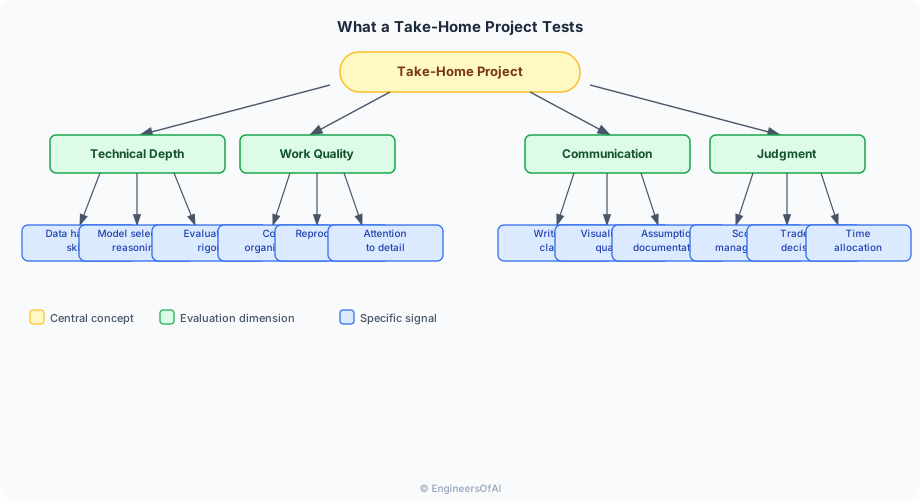
"Take-home projects test the complete workflow that a data scientist or ML engineer performs daily: receiving an ambiguous problem, exploring unfamiliar data, making modeling decisions under time constraints, and communicating results to stakeholders. Companies use them because they are the closest proxy to actual job performance - much closer than whiteboard algorithms or trivia questions."
The Hidden Evaluation Layer
Most candidates focus on model accuracy. Evaluators focus on process. Here is what a typical evaluation rubric actually weights:
| Evaluation Dimension | Weight | What Evaluators Look For |
|---|---|---|
| Problem Understanding | 15% | Did you correctly interpret the task? Did you identify ambiguities? |
| Data Exploration | 15% | Systematic EDA, insight extraction, documentation of findings |
| Feature Engineering | 15% | Thoughtful feature creation, domain awareness, handling of edge cases |
| Modeling Approach | 20% | Baseline comparison, appropriate model selection, sound evaluation |
| Code Quality | 15% | Clean, readable, reproducible, well-structured |
| Communication | 20% | Clear write-up, meaningful visualizations, honest about limitations |
Many candidates spend 80% of their time optimizing model performance (squeezing out an extra 0.5% accuracy) and 5% on communication and code quality. Evaluators often weight the opposite: a well-communicated solution with a solid baseline beats a marginally better model buried in messy notebooks.
Part 2 - Types of Take-Home Projects
Format 1: The Structured Dataset Challenge
This is the most common format. You receive a dataset (CSV, parquet, or database dump), a clearly defined prediction task, and specific deliverables.
Example prompt:
Using the attached dataset of 50,000 customer records, build a model to predict which customers will churn within the next 30 days. Your submission should include:
- Exploratory data analysis
- Feature engineering and selection
- At least two models compared
- Evaluation on a held-out test set
- A brief write-up (1-2 pages) of your approach and findings
What they are really testing: Can you execute a complete ML workflow with discipline and communicate your reasoning?
Format 2: The Open-Ended Exploration
You receive a dataset with minimal instructions. The prompt might say: "Here is a dataset of user interactions on our platform. What interesting insights can you find? Build something useful."
What they are really testing: Can you define a problem, scope your work, and prioritize without hand-holding?
Do not treat an open-ended prompt as an invitation to do everything. Candidates who submit 15 unfocused analyses with no narrative thread fail. Pick one or two compelling questions, answer them thoroughly, and explain why you chose those questions.
Format 3: The Implementation Challenge
You are asked to implement a specific algorithm, pipeline, or system component. This might be a recommendation engine, a text classification pipeline, or a data processing system.
What they are really testing: Can you write production-quality code, not just notebook experiments?
Format 4: The Design + Build Hybrid
You receive a business problem and must both design the solution approach and implement a prototype. This is common at startups and senior-level positions.
What they are really testing: Can you translate business requirements into technical solutions and execute on them?
Format 5: The LLM/RAG Challenge
Increasingly common since 2024. You might be asked to build a RAG pipeline, fine-tune a model for a specific task, design a prompt engineering solution, or evaluate LLM outputs.
What they are really testing: Can you work with modern AI tools and evaluate their outputs rigorously?

Part 3 - Time Expectations and Reality
What Companies Say vs. What They Mean
| Stated Expectation | Real Expectation | Strategic Approach |
|---|---|---|
| "2-4 hours" | 4-6 hours total | Tight scope, skip bonus questions if time-constrained |
| "4-8 hours" | 8-12 hours total | Full workflow expected, include write-up |
| "One weekend" | 10-20 hours | Comprehensive solution, code quality matters heavily |
| "One week" | 15-30 hours | Near-production quality expected |
| "No time limit" | Do not spend more than 20 hours | They want thoroughness, not obsession |
"We expect this to take about 4 hours" almost never means 4 hours. The prompt was designed by an engineer who already knows the data and the optimal approach. For a candidate seeing the data for the first time, add 50-100% to the stated time. Budget accordingly, and do not panic if you are "behind" the stated estimate.
The Unspoken Rules
- Never ask for an extension unless you have a genuine emergency. The time constraint is part of the test.
- Submit on time, even if imperfect. A clean, incomplete solution beats a messy, complete one.
- Document what you would do with more time. This shows awareness and maturity.
- Do not submit the night before if given a week. Submitting 2-3 days early signals confidence and preparedness.
- Track your time and report it honestly. Many companies ask how long you spent. Inflating or deflating hurts you.
Part 4 - The Strategic Framework
The PREPARE Framework
Use this framework for every take-home project:
| Step | Action | Time Allocation |
|---|---|---|
| P - Parse the prompt | Read 3 times, highlight requirements, identify ambiguities | 5% |
| R - Reconnoiter the data | Quick data profiling, understand shape and quality | 10% |
| E - Explore systematically | Focused EDA on task-relevant dimensions | 15% |
| P - Plan your approach | Choose models, define evaluation strategy, scope features | 5% |
| A - Analyze and model | Build baseline, iterate, evaluate properly | 35% |
| R - Refine and document | Clean code, write narrative, create visualizations | 20% |
| E - Edit and submit | Proofread, test reproducibility, final check | 10% |
# Example: First 30 minutes of any take-home project
import pandas as pd
import numpy as np

# Step 1: Parse the prompt (done offline, with pen and paper)
# - What is the prediction target?
# - What metrics matter?
# - What are the explicit deliverables?
# - Are there bonus questions? (prioritize later)

# Step 2: Reconnoiter the data
df = pd.read_csv("data/challenge_dataset.csv")

print("=" * 60)
print("DATASET OVERVIEW")
print("=" * 60)
print(f"Shape: {df.shape}")
print(f"Columns: {df.columns.tolist()}")
print(f"\nData types:\n{df.dtypes}")
print(f"\nMissing values:\n{df.isnull().sum()}")
print(f"\nTarget distribution:\n{df['target'].value_counts(normalize=True)}")
print(f"\nBasic statistics:\n{df.describe()}")

# This takes 2 minutes and tells you:
# - How big is the dataset (model complexity implications)
# - What types of features you have (numeric, categorical, text)
# - How much missing data exists (imputation needed?)
# - Is the target balanced? (evaluation metric choice)
What Separates Pass from Fail
After reviewing hundreds of take-home submissions as evaluators and mentors, the patterns are stark:
| Dimension | Failing Submission | Passing Submission |
|---|---|---|
| First impression | Untitled notebook, no README | Clear README with setup instructions |
| EDA | df.describe() and nothing else | Targeted visualizations with written insights |
| Modeling | Only one model, no baseline | Baseline + 2-3 models, proper comparison |
| Evaluation | Accuracy only, no train/test split | Multiple metrics, cross-validation, calibration |
| Code | One giant notebook cell | Modular functions, clear sections, comments |
| Communication | No write-up, or "I used XGBoost because it works" | Narrative explaining decisions and trade-offs |
| Edge cases | Ignores missing data, leakage | Documents assumptions, handles edge cases explicitly |
The three fastest ways to get rejected from a take-home:
- Data leakage - Using test set information during training (including scaling before splitting).
- No reproducibility - Evaluator cannot run your code. No requirements file, hardcoded paths, missing random seeds.
- Ignoring the prompt - You built a beautiful model but did not answer the question that was asked.
Part 5 - Company-Specific Patterns
Big Tech (Google, Meta, Amazon, Apple, Microsoft)
- Format: Structured dataset, clear deliverables, timed (often 48 hours to 1 week)
- Focus: Solid methodology, proper evaluation, clean code
- Gotcha: They test for data leakage and proper cross-validation rigorously
- Tip: Do not over-engineer. A well-executed logistic regression with proper evaluation beats a sloppy deep learning solution
AI Startups (OpenAI, Anthropic, Scale AI, Cohere)
- Format: More open-ended, often involving LLMs or novel tasks
- Focus: Creativity, production thinking, ability to work with ambiguity
- Gotcha: They expect you to define your own scope and justify it
- Tip: Show you can ship, not just research. Include a
requirements.txt, a clear README, and reproducible results
Finance (Two Sigma, Citadel, Jane Street, DE Shaw)
- Format: Time-series data, signal extraction, strict evaluation
- Focus: Statistical rigor, understanding of leakage in temporal data, risk awareness
- Gotcha: They will check for look-ahead bias and data snooping meticulously
- Tip: Use walk-forward validation, not random train/test splits
Healthcare / Biotech (Flatiron, Tempus, Genentech)
- Format: Clinical or biological data, interpretability required
- Focus: Domain sensitivity, ethical considerations, model explainability
- Gotcha: They care about false negatives vs. false positives differently than other industries
- Tip: Always discuss clinical implications of your model's errors
Some companies (particularly startups) are now offering paid take-home challenges - typically 500 for 4-8 hours of work. This is becoming more common as companies compete for candidates and recognize the significant time investment. If a company does not compensate you for a multi-day take-home, that is a signal about how they value your time.
Part 6 - Chapter Map
This section contains eight detailed chapters that cover every aspect of take-home projects:
| Chapter | Title | What You Will Learn |
|---|---|---|
| 1 | What Evaluators Want | Real evaluation rubrics, scoring criteria, what actually matters |
| 2 | Project Templates | Reusable templates for classification, NLP, time series, CV, RAG |
| 3 | EDA Best Practices | Systematic exploration, visualization, statistical testing |
| 4 | Model Selection Strategy | Baselines, model comparison, hyperparameter tuning, stopping criteria |
| 5 | Code Quality Standards | Notebook organization, functions, testing, reproducibility |
| 6 | The Write-Up | Structuring results, storytelling with data, follow-up prep |
| 7 | Time Management | Time allocation by format, scope management, the 80/20 rule |
| 8 | Common Mistakes | Data leakage, overfitting, poor evaluation, and how to avoid them |
Recommended Reading Order
If you have never done a take-home: Read chapters 1 through 8 in order. Each builds on the previous one.
If you have failed take-homes before: Start with Chapter 8 (Common Mistakes) to identify your failure patterns, then read Chapter 1 (What Evaluators Want) to recalibrate your priorities, then Chapters 5 and 6 for code and communication quality.
If you have a take-home due soon: Read Chapter 7 (Time Management) immediately, then skim Chapter 2 (Project Templates) for the template matching your task type, then Chapter 5 (Code Quality) for quick wins.
Part 7 - Your Take-Home Project Checklist
Use this checklist before submitting any take-home project:
TAKE_HOME_CHECKLIST = {
    "Before Starting": [
        "Read the prompt 3 times and highlight every requirement",
        "Identify the prediction target and evaluation metric",
        "Note explicit deliverables (notebook, write-up, presentation)",
        "Set a time budget with milestones",
        "Create a clean project directory structure",
    ],
    "Data Exploration": [
        "Profile the dataset (shape, types, missing values)",
        "Visualize target distribution",
        "Check for data quality issues",
        "Identify potential leakage sources",
        "Document key findings in markdown cells",
    ],
    "Modeling": [
        "Build a simple baseline first",
        "Use proper train/validation/test split",
        "Compare at least 2-3 approaches",
        "Use appropriate evaluation metrics",
        "Document model selection rationale",
    ],
    "Code Quality": [
        "Functions are documented and reusable",
        "Random seeds are set for reproducibility",
        "requirements.txt or environment.yml included",
        "No hardcoded absolute paths",
        "Code runs end-to-end without errors",
    ],
    "Communication": [
        "README with setup instructions",
        "Clear narrative in notebook markdown cells",
        "Visualizations are labeled and meaningful",
        "Write-up addresses all prompt requirements",
        "Limitations and next steps documented",
    ],
    "Final Check": [
        "Restart kernel and run all cells",
        "Verify all files are included",
        "Check for leftover debug prints",
        "Proofread write-up for typos",
        "Submit before deadline",
    ],
}
Practice Exercise: Evaluate a Sample Submission
Before you begin your own take-home projects, practice evaluating someone else's work. Read the following fictional submission summary and identify the problems:
Scenario: A candidate received a churn prediction task with 50,000 customer records and a 5-day deadline. Here is what they submitted:
- A single Jupyter notebook (unnamed:
Untitled3.ipynb) - The notebook starts with
import xgboost- no EDA section - All features are fed directly into XGBoost with default hyperparameters
- Evaluation:
accuracy_score(y_test, y_pred)- accuracy is 94% - No write-up, no README
- The target is 6% positive (churn) - the 94% accuracy is approximately the majority-class baseline
- No
requirements.txt - The notebook has cells that error out halfway through
Exercise: List every problem with this submission. For each problem, write one sentence explaining why it matters and what the candidate should have done instead. Then compare your list against Chapter 8 (Common Mistakes).
Interview Cheat Sheet
| Question | Key Points |
|---|---|
| "How do you approach a take-home project?" | PREPARE framework: Parse prompt, Reconnoiter data, Explore, Plan, Analyze, Refine, Edit |
| "What is the most important part of a take-home?" | Communication and process quality, not just model accuracy |
| "How do you manage time on a take-home?" | Set milestones, build baseline first, allocate 20% for write-up |
| "What is the biggest take-home mistake?" | Data leakage - using test information during training |
| "How do you handle ambiguous prompts?" | Document your interpretation, state assumptions explicitly |
| "What makes a take-home stand out?" | Clean code, thoughtful EDA, proper evaluation, clear narrative, honesty about limitations |
| "How do you choose your evaluation metric?" | Based on the business problem: precision vs recall trade-off, class imbalance, cost of errors |
| "Should you use the most complex model?" | No. Start simple, add complexity only when justified by improvement |
Next Steps
You now understand the landscape of take-home projects, how they are evaluated, and the strategic framework for approaching them. In the next chapter, we dive deep into What Evaluators Actually Want - the real scoring rubrics, hidden criteria, and what separates the top 10% of submissions from the rest.